A year after changes to federal leadership in the U.S. public health system, a new poll finds that trust in public health agencies has dropped dramatically. Only 50% of U.S. adults say they trust health recommendations from the Centers for Disease Control and Prevention (CDC), compared to 77% in spring 2025. The fraction who say they trust their state health department has declined from 80% to 66% and the fraction who say they trust their local public health department has fallen from 82% to 70%.
Trust in public health agencies takes a tumble
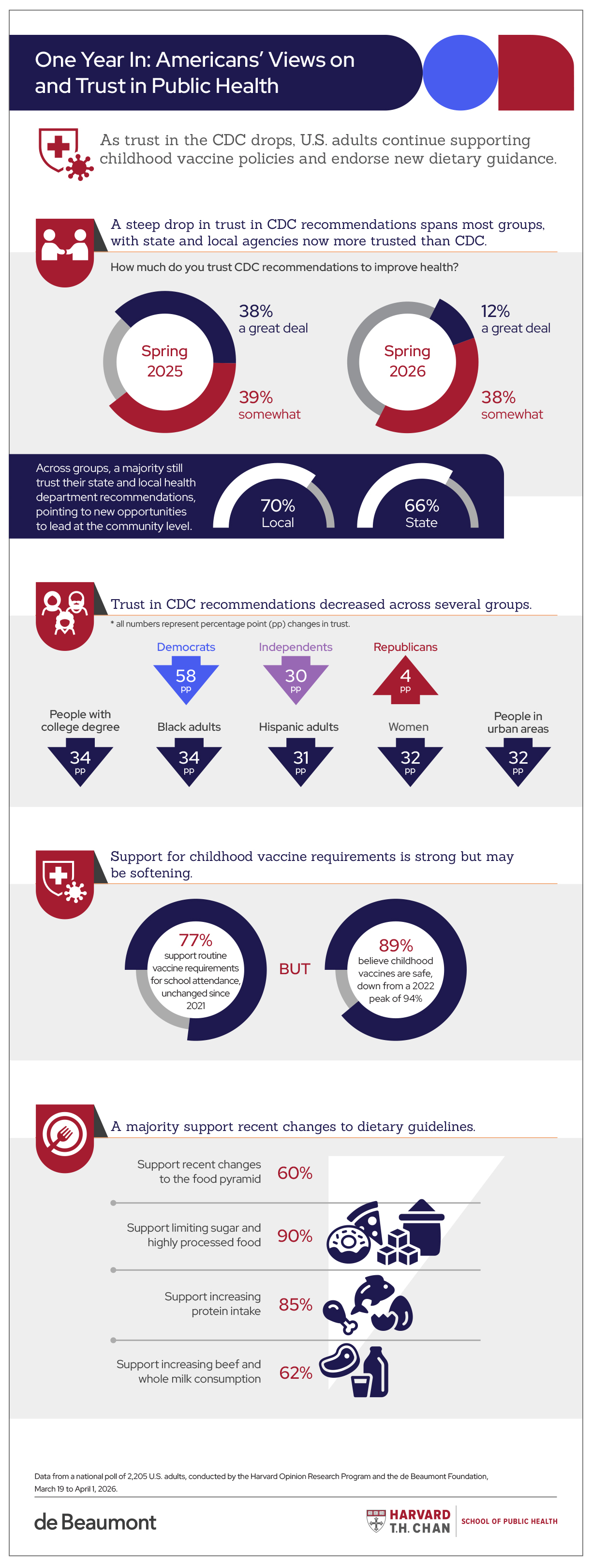
Data from a national poll of 2,205 U.S. adults, conducted by de Beaumont and the Harvard Opinion Research Program.
Trust in CDC health recommendations remained relatively stable in the wake of the COVID-19 pandemic but has fallen precipitously in the last year. Trust hovered around 75% from 2022 to 2025; a year into new federal leadership, it declined to 50%. The fraction of the public saying they trust CDC health recommendations includes about a third (38%) who say they trust them “somewhat” and a small share (12%) who say they trust them “a great deal.”
This decline in trust is driven by deep partisan divides. From 2025 to 2026, trust in CDC health recommendations has fallen from 92% to 34% among Democrats and from 77% to 47% among Independents. This steep drop also translates to losses in trust across demographic groups. Trust in the CDC has fallen more than 30 percentage points among women (80% to 48%); Black and Hispanic adults (77% to 43% and 81% to 50% respectively); those living in urban areas (80% to 48%); and those with a college degree (80% to 46%). Meanwhile, trust among Republicans has increased very slightly, from 63% to 67%.
“The link between political affiliation and trust in public health institutions is worrisome and doesn’t bode well for the future,” said de Beaumont president and CEO Brian C. Castrucci. “Decision makers can and will have differing views on the best policy solutions to public health challenges, but it’s important for them to be grounded in a common set of facts. Science should not be a point of view. Once facts are politicized, it becomes increasingly difficult to bridge the divide.”
Trust in state and local public health agencies has also fallen in the last year, but not as dramatically. Between 2025 and 2026, trust in state public health agencies dropped from 80% to 66%, while trust in local public health agencies dropped from 82% to 70%. State and local health departments are now substantially more trusted than federal agencies such as the CDC (50%) or the U.S. Food and Drug Administration (FDA) (53%).
Approval of federal public health agencies’ actions falls along party lines
A slim majority (55%) of the U.S. public disapproves of federal public health agencies’ actions in the past year, with disapproval strongly linked to partisan identity. Most Democrats (86%) disapprove, but only one in five Republicans (20%) say the same.
Top concerns about federal health agencies’ actions under new leadership include wide agreement from the public that their recommendations were too influenced by leaders’ personal beliefs (68%) or focused too much on the wrong priorities (66%). About six in ten agree that agencies have cut or scaled back programs too much (61%), made too many decisions without following standard processes (60%), and cut or scaled back government funding for health or medical research too much (60%).
There is less public agreement with neutral and positive statements regarding federal health agencies’ actions. Less than half agree that agencies have put decisions back in the hands of families (46%) or have been trying to do the right thing (44%). Only about a third agree that federal health agencies have made recommendations that follow the best available scientific evidence (38%), have had a positive impact on the health of average Americans (37%), or have represented the interests of people like them (35%).
Support for childhood vaccination remains strong across party lines, but may be softening
A year into new federal public health leadership, there is still strong majority support for routine childhood vaccination requirements. More than three-quarters (77%) of the public say that parents should be required to vaccinate their children in order to attend school, which has been nearly the same since the COVID-19 pandemic (range of 74% to 79% between 2021 and 2025). Though there are differences in vaccine support by political party, notable majorities of both parties — 91% of Democrats and 65% of Republicans — say that parents should be required to vaccinate their children in order to attend school.
Nonetheless, there are some indications that vaccine support may be softening. While a majority of U.S. adults (58%) oppose reducing the childhood vaccine schedule, which forms the basis of childhood vaccine requirements, there is substantial minority support (42%) for this policy change. Nearly two-thirds of Republicans (65%) support reducing the childhood vaccine schedule, compared to fewer than one in five Democrats (18%).
Another indication of possible softening vaccine support comes from a slight dip in the fraction of people saying that childhood vaccines are safe. Overall views on childhood vaccine safety are high at 89%, but have declined slightly from 94% during the peak of the COVID-19 pandemic (2021–2022). This overall decline includes a decrease in the fraction of the public saying childhood vaccines are “very safe,” which now stands at 57%, down from a high of 70% during the peak of COVID-19. Strong shares of adults in both parties say vaccines are safe overall, with 85% of Republicans and 96% of Democrats saying childhood vaccines are “very safe” or “somewhat safe,” but there is a wide gap in the subset saying vaccines are “very safe” (46% of Republicans versus 76% of Democrats).
“Social media and news coverage tend to elevate the loudest voices that question or outright oppose vaccines, so it can often feel like there is a rise in anti-vaccine sentiment amongst the general public. The reality is that the vast majority of people support vaccines for children and believe they are safe,” said Gillian K. SteelFisher, survey lead and principal research scientist at Harvard Chan School.
“That said, it is true that many families are questioning the necessity of vaccines and weighing what vaccine requirements mean for their parental authority. Healthcare providers and public health communicators need to be able to address these concerns with empathy and compassion,” she added.
Strong support for changes to the food pyramid, but partisan patterns persist at a high level
A majority of the public (60%) supports the recent changes to the food pyramid and the Dietary Guidelines for Americans, and even stronger majorities support specific measures, including recommendations to avoid or sharply limit sugar and highly-processed food (90%) and recommendations to increase protein intake (85%). A smaller majority (62%) supports recommendations to increase beef and whole milk consumption.
Support is bipartisan for limiting sugar and highly-processed food (Republicans: 94%, Democrats: 89%) and for increasing protein intake (Republicans: 92%, Democrats: 79%). But there is partisan division when considering support for overall changes: 83% of Republicans say they support changes to the food pyramid, compared to only 37% of Democrats. Support for recommendations to increase beef and whole milk consumption is also divided, with 80% support among Republicans and 44% support among Democrats.
The poll, One Year In: Public Views of a Changing Public Health Landscape, was conducted by the de Beaumont Foundation’s Public Health Listening Lab and Harvard T.H. Chan School of Public Health from March 19 to April 1, 2026, among a probability-based, nationally representative sample of 2,205 U.S. adults ages 18+. The poll was supported by the de Beaumont.