A new roadmap for partnerships is bringing renewed focus to investing in relationships between elected officials and public health experts.

Explore the Good Health is Good Governance toolkit.
The roadmap is the recently released “Good Health is Good Governance” toolkit. The work of the National Commission on Local Public Health Leadership, the toolkit equips elected officials and local public health leaders with practical, nonpartisan ways to strengthen collaboration, enabling scientific evidence to be translated into effective policy and community action. Rising distrust, particularly at the federal level, makes it critical for local elected officials and public health leaders to have the tools, resources, and skills to work together effectively.
“[Through] our polling results…we’ve recently found that there is a high degree of trust among the public when it comes to receiving health information from their local and state health departments,” said de Beaumont program officer Lynne Lê during an online presentation about the toolkit and strengthening partnerships.
This high trust, combined with their work on a range of issues that impact community health and well-being, makes strong collaboration among these officials and leaders vital and impactful.
“A lot of public officials run on the platform of economic prosperity, community safety, and educational outcomes,” Lê said. “Well, a healthy workforce is a strong workforce, which is a strong local economy, right?”
Putting Toolkit Principles into Practice
In her presentation, Lê discussed the Commission’s recommendations from the toolkit — all focused on building effective relationships between elected officials and public health leaders. Importantly, as Lê said, they were also “developed with the idea of being practical, immediately usable, and widely applicable across the country, whether you’re from a smaller area, a rural area, all the way to some of our larger metropolitan areas. The foundational concepts of relationship building are the same.”
Principles highlighted in the toolkit include:
- Commit: Making a proclamation about working together to improve community health is an important first action. A proclamation, signed and celebrated, signals to the public that working together is a priority, and toolkit templates give community leaders an easy way to customize their own.
- Connect: Relationship building is about connecting. Sample language for starting a conversation and for what questions to ask is a key part of the toolkit. Plus, email examples include explanations of what works and what doesn’t.
- Clarify: Knowing the roles and responsibilities leaders play is key to strong relationships. To support that, the toolkit provides questions to help ensure all parties involved know who is doing what.
- Act: Leaders can get the most from the relationships they’ve built by putting them into action. The toolkit suggests ways to do this, such as committing roles and responsibilities to writing and holding preparedness planning meetings, to organize partners ahead of the next disaster or outbreak.
Strategies and Recommendations to Support Strong Partnerships
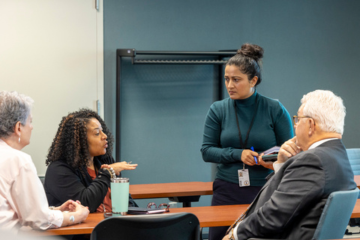
To capture a real-world perspective and strategies for elected officials and public health leaders to work together, Lê facilitated a discussion following her presentation that included Lenny Eliason, a member of the National Commission on Local Public Health Leadership and a commissioner for Athens County, Ohio; Laurie-Anne Sayles, councilmember-at-large for Montgomery County, Maryland; and Mtokufa Ngwenya, senior director of government affairs at CityHealth.
Here are some of the tips they shared:
- Build relationships before the crisis. To navigate big challenges, it’s important to have done the work up front to build trust, understand roles, share data, establish mutual respect, and connect frequently around shared commitment to the people being served.
- Share seats at each other’s tables. Having local health department staff attend regular local planning commission meetings can help build rapport among staff and make sharing expertise and information a standard practice.
- Listen more than you speak. Be an active listener who seeks to understand instead of win arguments and use the information and facts you collect to create better solutions for the community.
- Get to know people. Understanding the people you’re working with can go a long way. Identifying what you have in common, what a colleague’s motives are, or something personal to connect over can help you approach them with greater familiarity, fostering more open dialogue and respect.
View the webinar and access the toolkit to learn more about ways to strengthen partnerships in your work.