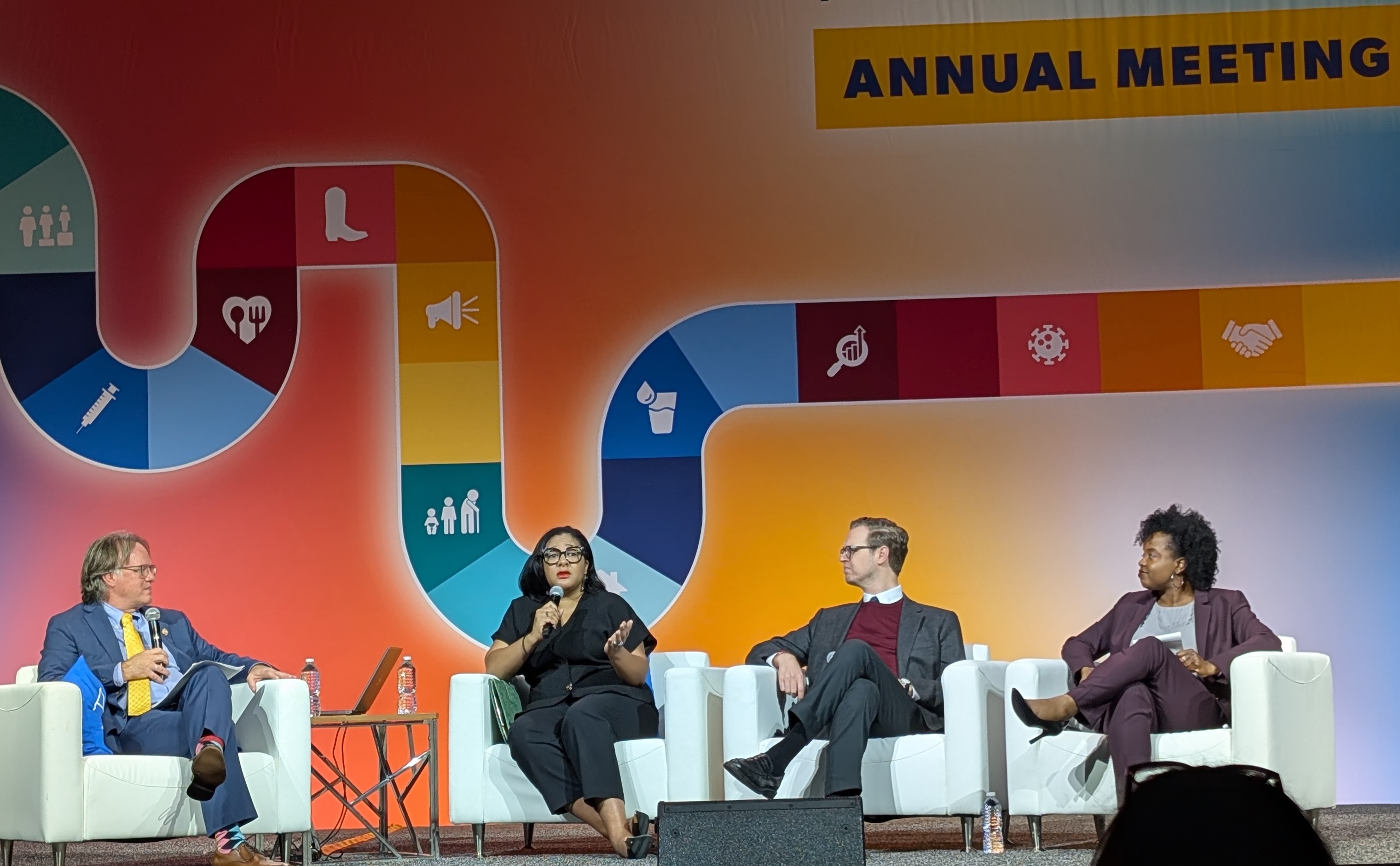
From left to right: David Lakey, Katrina Forrest, Sami Jarrah, and Jamila M. Porter.
Public health training imparts a deep knowledge of its disciplines, but to truly make change, practitioners need more than subject matter expertise. That’s the premise behind the public health Strategic Skills, a set of nine essential, cross-cutting skills that span specialty areas and roles to address the new challenges and ever-shifting focus of the workforce. Each skill is the focus of an actionable, practice-oriented book in the Strategic Skills for Public Health Practice series.
At a main stage champion conversation during the American Public Health Association 2026 Annual Meeting this month, series authors explored the need for and interplay among three of the strategic skills: policy engagement, equity and justice, and resource management. David Lakey, vice chancellor for health affairs and chief medical officer at the University of Texas System, moderated a panel discussion featuring Katrina Forrest, executive director of CityHealth and co-author of Policy Engagement; Sami Jarrah, vice dean for finance and administration at the Columbia University Mailman School of Public Health and author of Resource Management and Finance; and Jamila M. Porter, principal investigator of Modernized Anti-racist Data Ecosystems (MADE) for Health Justice, and chief of staff at the de Beaumont Foundation, and co-author of Advancing Equity and Justice.
The speakers opened the session by explaining the growing need for strategic skills in public health leadership, especially as professionals advance in their careers. “The skills that got you into the role aren’t necessarily the same skills you need to manage or lead a program,” Jarrah said.
Forrest put it more bluntly, stating, “These skills are no longer optional.”
The Messiness of Real-World Problem-Solving
Power — including who has it, when and how it is used, and how openly it is addressed — was a major theme of the discussion. “Public health is inherently about power and inherently political,” Porter said. “We can’t pretend we’re above the fray. We’re part of the fray. In fact, the fray is about us.”
Forrest advised that at the outset of a multi-sector advocacy effort, public health professionals and their collaborators map the power dynamics involved: who makes decisions, how they make decisions, and who influences their decision making. By mapping power, advocates can decide where to best direct their resources and messaging.
The speakers candidly discussed the realities of tradeoffs and compromise in making long-term change. “One of the biggest mistakes I see in our field is treating compromise as surrender,” Forrest said, sharing as an example the numerous incremental successes that drove the decades-long effort to raise the minimum age for purchasing tobacco and nicotine products to 21.
Porter had a different perspective, encouraging attendees to “shoot for the moon, and ask for what you want.” Unfortunately, when policy compromise happens, it is often marginalized populations who end up being left out or overtly harmed, she pointed out.
Surfacing tradeoffs is key to resource allocation as well, Jarrah explained. In an idealistic, mission-driven environment of professionals who want to fix everything, this can be a difficult conversation, “but our tendency toward conflict aversion ends up harming the field,” he said. “In public health, we tend to try to move 50 priorities one inch each. If we choose where to focus, we can do so much more.”
The Strategic Skills for Public Health Practice series from APHA Press and de Beaumont supports members of the workforce in developing skills that span public health disciplines and help to build strong partnerships across sectors.