Explore the Engaging Business Leaders in Public Health Partnerships toolkit.
The link between America’s public health and economic well-being is inextricable — achieving prosperity relies on having healthy and safe places to live, work, and play. Yet while public health routinely partners with sectors like housing, transportation, health care, and education to support community well-being, the private sector is often left out.
That’s a missed opportunity. Businesses play a powerful role in shaping community conditions like workforce stability, economic vitality, and local policy environments. In many communities, employers are trusted voices and key decision makers whose support can strengthen public health efforts. When done strategically and intentionally, partnerships between business leaders and public health organizations can help communities address complex challenges, prepare for future crises, and advance health and safety.
Launching today, Engaging Business Leaders in Public Health Partnerships provides public health professionals a research-based, practical roadmap to initiate and deepen engagement with private sector leaders in ways that feel relevant, effective, and aligned with both business priorities and public health goals. The toolkit includes:
- Audience insights that explain the friction between businesses and public health
- An engagement formula for engaging with business leaders
- Guidance on which types of businesses to engage and when
- Message do’s and don’ts
- Recommendations for the role of local public health departments
Understanding the Relevance Gap
The biggest challenge to engaging business leaders is not opposition — it’s relevance. Focus groups with corporate social responsibility (CSR) leaders from large corporations, trade association executives, and local business owners revealed three key barriers that make public health feel disconnected from private sector priorities.
Unrelated to Mission: Public health feels unrelated to a business’ mission. Many business leaders equate public health with regulation, political advocacy, or crisis response; a narrow mental model that makes it difficult to see how they can add value and imagine what kinds of collaborations may be possible. Without concrete examples, they default to thinking it isn’t their lane.
Long-term and Abstract: Business leaders are focused on near- or mid-term goals like revenue, profitability, and workforce reliability, while public health is seen as a generational or long-term endeavor with unclear or distant payoffs. As a result, public health can be perceived as “nice to have” rather than aligned with core business needs.
Polarizing: Businesses worry that involvement in public health efforts could signal political partisanship and alienate customers or employees. Specifically, interactions with government health departments can feel reputationally risky. This perception limits the range of issues businesses are willing to engage on, narrows the set of acceptable partners, and hampers potential collaboration before it begins.
Devising Partnerships that Maximize Alignment
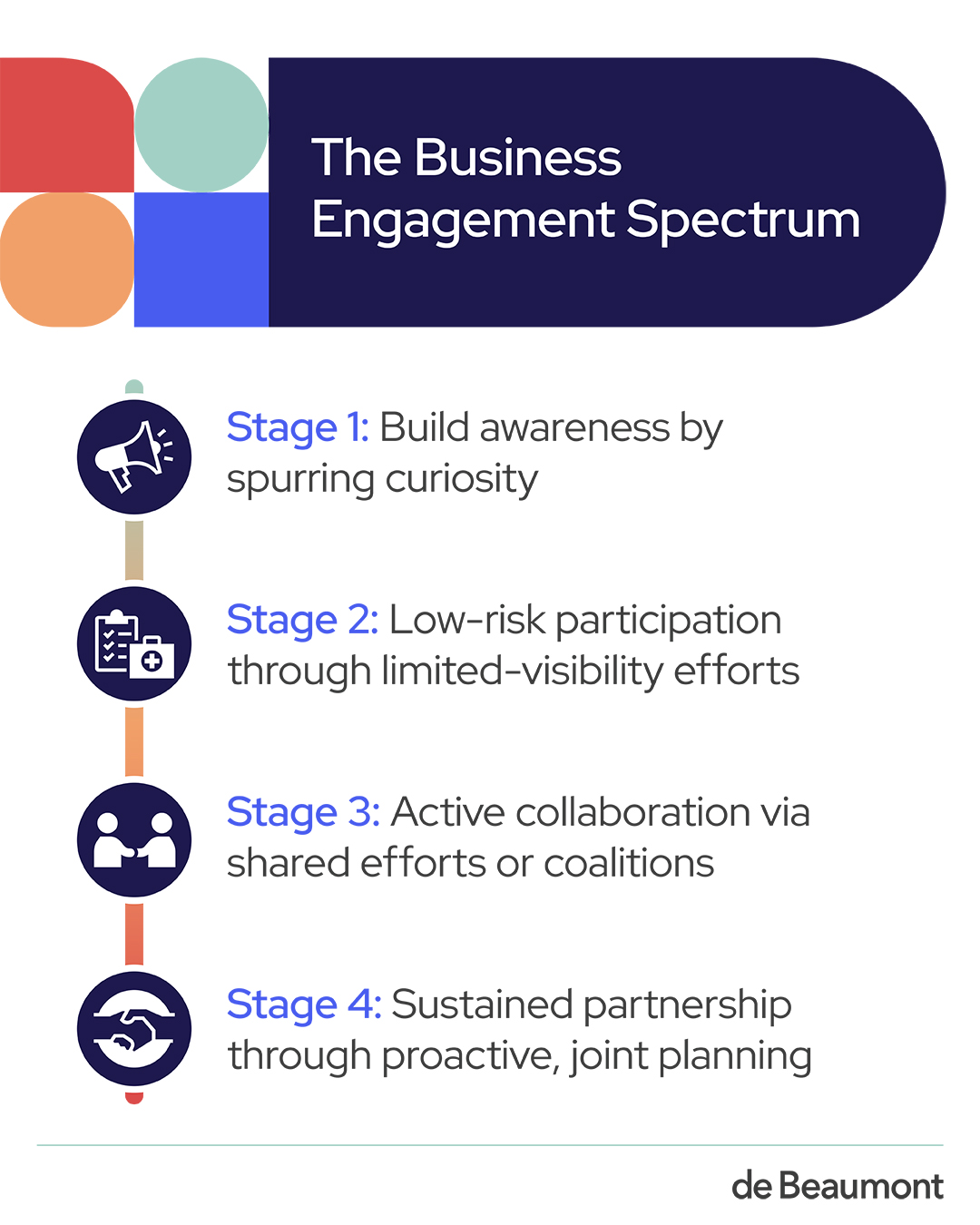
Use the business engagement spectrum when considering the level of engagement a business is realistically prepared for.
The business community is not a monolith, and not all private sector partnerships need to look the same to be successful. There’s a spectrum of ways that businesses and public health can partner, ranging from building awareness and limited-visibility engagements to participation in a coalition to a sustained, generative collaboration. Partnerships often start small, such as around a specific public health topic that’s intuitively connected to the mission of the business, and grow into an ongoing relationship as mutual appreciation and trust develop.
The toolkit helps practitioners navigate this spectrum by outlining which types of business entities to engage, who within them to target, and ways to motivate them to get involved in issues or activities of focus. It includes practical tools such as thought exercises, examples, and worksheets to spur internal thinking about a business partnership strategy, along with messaging guidance to make the initial outreach as compelling and relevant as possible.
Engaging Business Leaders in Public Health Partnerships, released in May 2026, is based on an extensive round of research conducted in November 2025 with leaders from large corporations, trade associations, and local businesses across the U.S. Two focus groups included corporate social responsibility leaders, two included state and local trade association leaders, and one included small and medium local business owners.
For additional guidance and tested messaging, see Communicating about Public Health with Policymakers and Communicating about Public Health: A Toolkit for Public Health Professionals, both released in 2025.