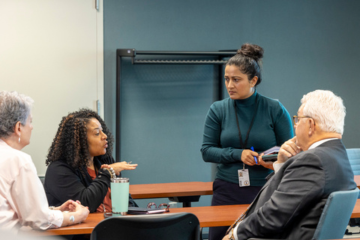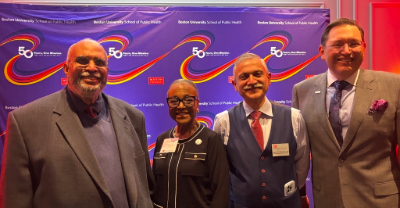
(L-R) Panelists Dr. Georges Benjamin, Dr. Linda Alexander, Dr. Adnan Ali Hyder, and Dr. Brian C. Castrucci. (Photo courtesy BUSPH).
Often in public health, we find ourselves drawn into the issue of the day, marshaling resources and staff to address an emerging threat or to launch a new program or service. But last week, in celebration of the Boston University School of Public Health’s (BUSPH) 50th anniversary, we took a moment to consider bigger-picture questions about the vision, purpose, and future of the field.
At The Future of Public Health in the United States, moderated by Dean Adnan Ali Hyder of BUSPH and featuring speakers Linda A. Alexander of the Association of Schools and Programs of Public Health, Georges C. Benjamin of the American Public Health Association, and de Beaumont president and CEO Brian C. Castrucci, attendees considered their hopes for the next 50 years of public health and ways to achieve this vision.
Alignment as a Starting Point for Action
“Fifty years from now, I want to be in a world where people value their health,” Dr. Castrucci said. Reflecting on the need for better alignment, agreement, coordination, and partnership across the varied organizations involved in public health, he encouraged attendees to “disentangle this moment from where we’re going in the next 50 years.”
Broadening this idea, Dr. Benjamin cited the need for ongoing advocacy, including beyond public health organizations, and for “optimal health for all [to be] seen as a shared goal.” He called out the importance of government taking a leadership role in health, with coordination across federal, state, and local entities.
With professional associations and philanthropy represented on the panel, the speakers reflected on the roles of their own organizations in driving change. “Finding common ground, intentionally reaching beyond the choir, and leading by example” are places where associations can play a key role, Dr. Alexander said. She emphasized the importance of first seeking to understand, and then using that understanding to find opportunities for partnership.
Attendees echoed the theme of connecting today’s needs to the systems in which public health work takes place, including the value of being open to rethinking those systems and the incentives they foster when they no longer serve the purpose of improved community health.
Opportunity at the Community Level
While national politics has an unmistakable influence on state and local public health work, the reverse can also be true. All speakers alluded to creativity and excellence happening locally, including through local policy and unusual partnerships, that have the potential to inspire similar programming in other communities and be scaled up to states or nationwide.
Dr. Castrucci cited specific de Beaumont programs seeking to uplift successful local approaches, including the National Commission on Local Public Health Leadership launched in 2025 and the Public Health Leadership Academy launched this year with the National Association of Counties.
In closing, panelists urged attendees to take part in political discussions, even and perhaps especially when there’s disagreement. “In public health, we’re very proud of the fact that when we do our best work, it’s invisible,” Dr. Benjamin said. “We need to become more visible.”
The Future of Public Health in the United States, which took place April 29, 2026, in Washington, DC, was part of Boston University School of Public Health’s 50th anniversary programming. Watch the event on BUSPH’s YouTube channel and read a recap from Dean Hyder.