
The Public Health Workforce Interests and Needs Survey (PH WINS) Islands Pilot was conducted by the de Beaumont Foundation, the Association of State and Territorial Health Officials (ASTHO), and the Pacific Islands Health Officers Association (PIHOA) between February and May 2025. This was the first time the survey was offered to U.S. Territories and Freely Associated States. The PH WINS Islands Pilot captured individual workers’ perspectives on key issues as well as demographic information on the government public health workforce in eight Territories and Freely Associated States.
The 2025 survey was distributed online to 8,913 government public health workers and completed by 2,556 employees, for a 28% response rate among eligible employees. For more information, see Behind the Numbers.
Islands Pilot Key Findings
Click to download graphic
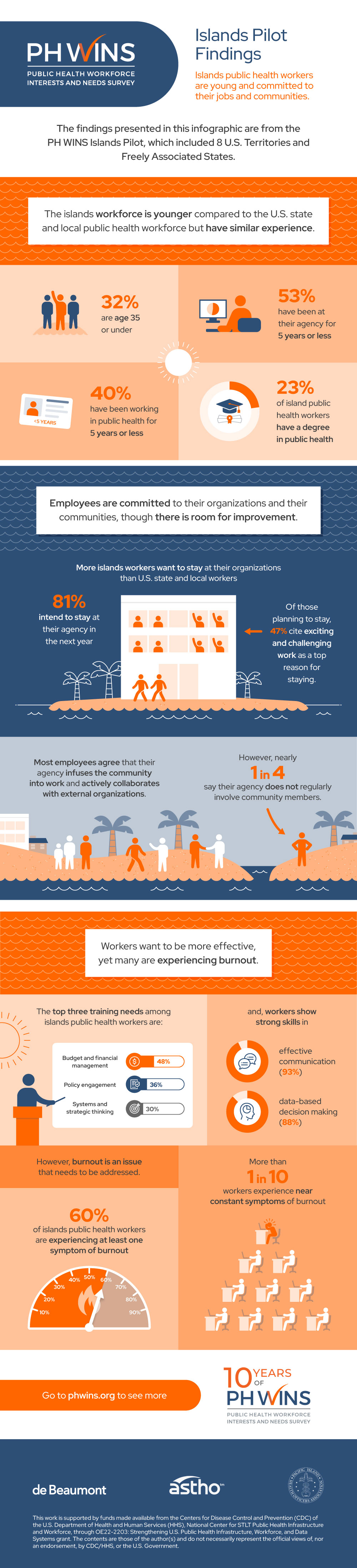
- Education: Most of the Islands’ public health workforce (77%) does not have a public health degree; 84% have a college degree (associates, bachelors, masters, or doctoral).
- Age and Tenure: The Islands’ public health workforce is young. Nearly a third (32%) are age 35 or under, more than half (53%) have been at their current agency for five years or less, and 40% have been working in public health for five years or less.
- Staying and Leaving: Most (81%) of the Islands’ public health workforce intend to stay at their organization for the next year, 15% are planning to leave within the next year, and 4% are planning to retire within the next year. Among those planning to leave in the next year, 14% are planning to take another government job in public health. The most common reason cited among employees intending to leave is pay (54%), followed by lack of opportunities for advancement (40%). Among employees intending to stay, the most cited reasons for staying are support (52%), flexibility (48%), job stability (48%), job satisfaction (47%), and exciting and challenging work (47%).
- Burnout: Over half (59%) of the Islands’ public health workforce reported one or more symptoms of burnout, with 13% reporting near-constant burnout.
- Training Needs: The top three training needs for the Islands’ public health workforce are: budget and financial management (48%), policy engagement (36%), and systems and strategic thinking (30%).
- Community Engagement: Most of the Islands’ public health workforce (80%) agree that their agency infuses the community into their work and actively collaborates with community-based organizations (86%). Fewer employees felt that their agency regularly involves community members affected by proposed programs (74%) and that their agency prioritizes community members’ input when determining health department priorities (73%).
View a summary of the Islands data, available on the PH WINS dashboards.
Pacific Islands Key Findings
Click to download graphic
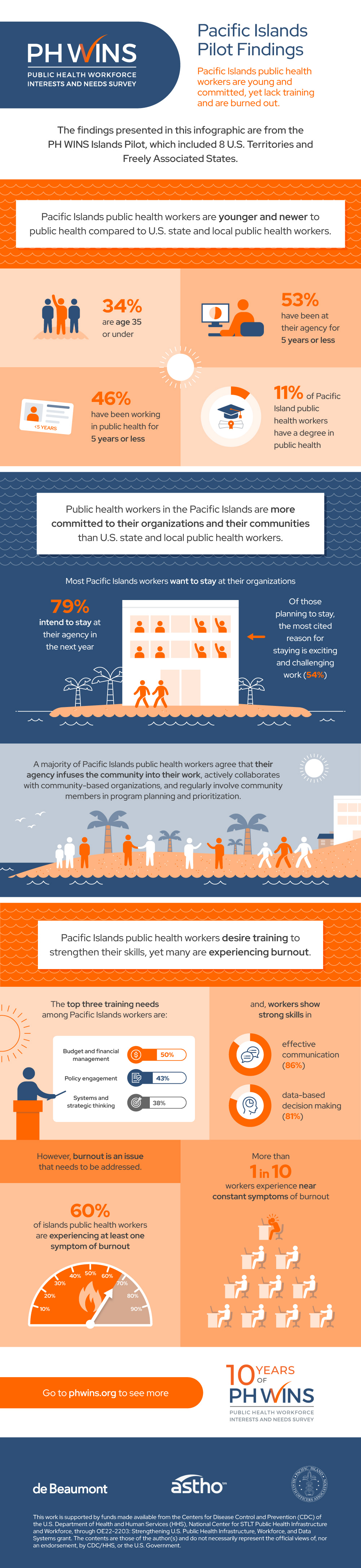
- Education: Most of the Pacific Islands’ public health workforce (89%) does not have a public health degree; 59% have a college degree (associates, bachelors, masters, or doctoral).
- Age and Tenure: The Pacific Islands’ public health workforce is young. More than a third (36%) are age 35 or under, more than half (56%) have been at their current agency for five years or less, and 52% have been working in public health for five years or less.
- Staying and Leaving: Most (78%) of the Pacific Islands’ public health workforce intend to stay at their organization for the next year, 19% are planning to leave within the next year, and 3% are planning to retire within the next year. Among those planning to leave in the next year, 14% are planning to take another government job in public health. The most common reason cited among employees intending to leave is pay (46%), followed by work overload/burnout (36%). Among employees intending to stay, the most cited reasons for staying are exciting and challenging work (56%), job stability (54%), support (53%), training opportunities (50%), and job satisfaction (46%).
- Burnout: More than two-thirds (69%) of Pacific Islands’ public health workforce reported one or more symptoms of burnout, with 14% reporting near-constant burnout.
- Training Needs: The top three training needs of the Pacific Islands’ public health workforce are: budget and financial management (48%), policy engagement (45%), and systems and strategic thinking (41%).
- Community Engagement: Most of the Pacific Islands’ public health workforce (87%) agree that their agency infuses the community into their work and actively collaborates with community-based organizations (92%). Fewer employees felt that their agency regularly involves community members affected by proposed programs (85%) and that their agency prioritizes community members’ input when determining health department priorities (86%).
Islands Workers Age 35 and Under
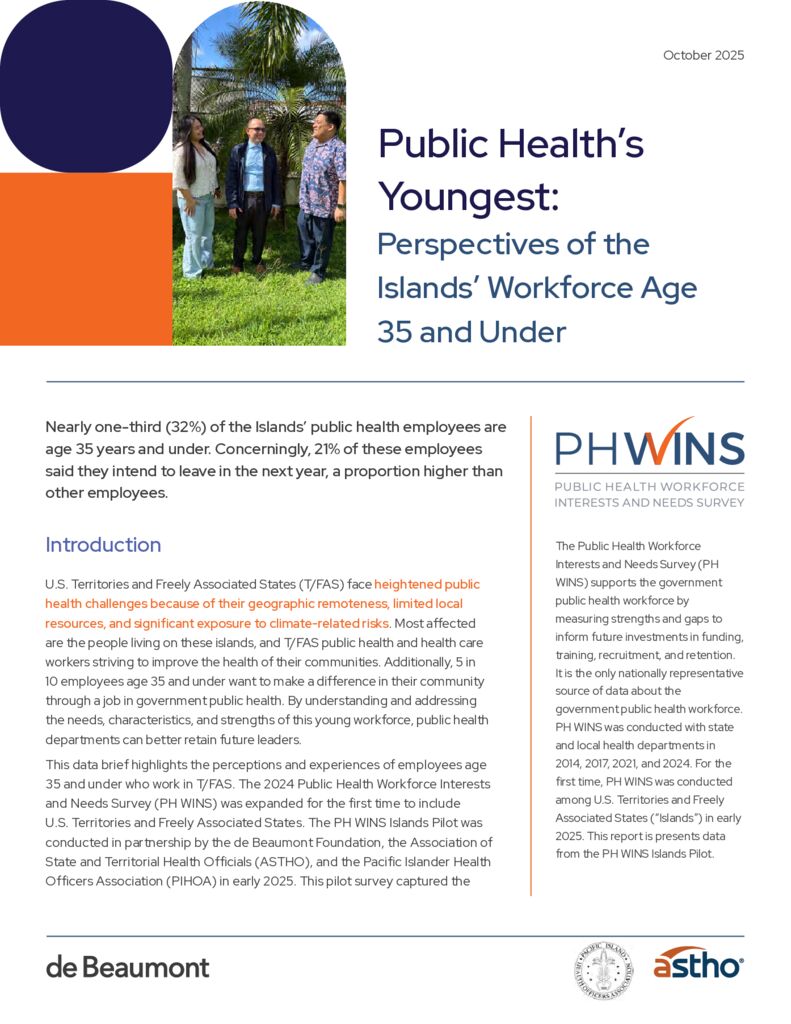
Nearly one-third (32%) of the Islands’ public health employees are age 35 years and under. Concerningly, 21% of these employees said they intend to leave in the next year, a proportion higher than other employees. By understanding and responding to the needs, characteristics, and strengths of the young workforce, Islands’ public health departments can improve the retention of this population of future leaders.
Key Findings
Click to download PDF
- Nearly one-third (32%) of the Islands’ government public health workforce is 35 and under
- Many young professionals come to Islands’ government public health from another job (61%), and half (50%) are attracted to the ability to do meaningful work and serve others
- More than one in five young professionals (21%) intend to leave their agency in the next year
- Nearly one in three (29%) of the Islands’ 35 and under workforce earn post-secondary public health degrees, compared to 21% of their older counterparts
Survey and Data Access
View the PH WINS Islands Pilot Instrument:
- PH WINS Islands Pilot (English)
- PH WINS Islands Pilot (Spanish)
To request a special analysis, raw data to conduct your own analysis, or coaching on interpreting and acting on the results, please fill out this short form. If you are requesting raw data to conduct your own analysis, please review the appropriate instrument linked above and the online codebook.
Please note that to protect confidentiality and anonymity of employees who took PH WINS, health departments will not be granted access to their department’s raw data.