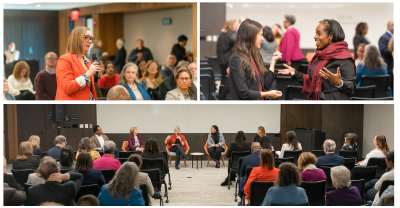
At the Mission Critical summit, public health workforce leaders rallied to pursue bold solutions, with PH WINS as the anchor. (Credit: Johnny Shryock)
Resilient is a word that has come to define the government public health workforce. Employees are praised for their ability to navigate funding instability, respond to crises, and continue showing up for their communities, often under immense pressure. While the narrative is true, it doesn’t address why the workforce must be so resilient in the first place.
Public health employees’ grit is just one slice of a bigger, more complex narrative. Workforce data shows us the full picture, cracks and all. Even though these shortcomings are difficult to confront, knowing where the workforce stands allows for more deliberate, evidence-based solutions to longstanding challenges.
Reenergizing the Field
For over a decade, the Public Health Workforce Interests and Needs Survey (PH WINS) has been an invaluable source on the experiences, needs, and priorities of government public health employees. As the only nationally representative dataset of its kind, PH WINS has shaped funding decisions, workforce strategies, and national conversations. Insights from PH WINS data are a key starting point to effect change, and the latest findings are spurring reflection on how to reenergize a dedicated yet strained workforce.
PH WINS 2024 highlights a workforce of younger employees new to public health. Many are deeply committed to public service but face high levels of burnout and mental health struggles, with some considering leaving their jobs in state and local health departments.
The findings are especially pertinent as remote work and emerging technologies shape public health practice. Government public health must be rooted in a people-first approach, fostering mentorship, work-life balance, hands-on learning, and community engagement. The field also needs to embrace new ways of thinking driven by younger professionals, creating a reciprocal learning environment that strengthens all generations.
These and other forward-thinking approaches were explored at the 2025 “Mission Critical: Rebuilding the Public Health Workforce” summit. Hosted by the de Beaumont Foundation, the Johns Hopkins Bloomberg School of Public Health, and the Consortium for Workforce Research in Public Health in November 2025, the event rallied leaders to pursue bold solutions, with PH WINS as the anchor. Conversations at the summit involved people who run health departments under budget constraints, leaders who train the next generation of public health professionals, and academics whose research focuses on public health workforce trends.
“We’re not going to move into the future with the tools of the past,” said de Beaumont president and CEO Brian C. Castrucci, stressing the importance of reenergizing the workforce and being more strategic in efforts to rebuild it.
This is the logic behind Insights to Action, a suite of resources designed to help state and local public health agencies use PH WINS data to enact change. Here’s what real members of the workforce say they need to thrive and the actions that leaders can take to help staff achieve their goals.
Investing in People as Strategy
At its core, rebuilding the workforce is about investing in people.
“We can help train people who not only embrace and have a vision for the world but also know how to strategically function in the world now,” said Keshia Pollack Porter, Dean of the Johns Hopkins Bloomberg School of Public Health, at the summit.
That includes creating clear pathways for leadership, expanding access to training, and supporting staff at all stages of their career. Health departments need to be intentional about workforce development and leadership training for staff at all levels. Low- and no-cost training opportunities, peer learning, and leadership development can bolster workplace morale and capacity.
Create a Workplace that Retains Talent
Retention is shaped by culture as much as compensation. The agencies that weather funding shifts will be the ones that plan for them.
- Lead with transparency: How leaders communicate with staff through uncertainty is important. Clearly and regularly communicating priorities, even when the answers are incomplete, builds the kind of trust that keeps people.
- Invest in development — without waiting for new funding: Expand access to low- and no-cost training opportunities. Resources like the Building Expertise in Administration and Management (BEAM) certificate program or the Public Health Communications Collaborative (PHCC) Academy make that investment in career growth accessible without requiring a significant budget.
- Mentor intentionally: Provide structured guidance for students and early-career professionals while tapping into the knowledge of new tools, technologies, and approaches.
- Create clear pathways with career ladders: Use career ladders to spell out the interpersonal and technical skills, tools, and experience needed at each level, helping staff see how to grow and advance into leadership.
Rethink How Work Gets Done
Salary increases aren’t always possible, but offering flexibility can be. “Flexibility doesn’t cost money, but it pays dividends when it comes to retention, productivity, and morale, said Meena Brewster, Health Officer at St. Mary’s County Health Department in Maryland. Health departments across the nation have developed creative solutions even amid budget constraints.
- Expand flexible work options: Use remote, hybrid, or alternative work arrangements as competitive tools to improve retention and satisfaction.
- Leverage flexibility strategically: Remote or hybrid work could enable rural workers to stay connected to their local communities while contributing to broader teams across a county or state.
- Invest in the infrastructure: Ensure staff have the tools and technology needed to make remote work effective across geographical settings, such as adequate equipment and connectivity speeds.
Build a Workplace Where People Feel Safe and Supported
Workforce well-being requires creating intentional systems and leaders who foster supportive, valued environments where staff can ask for help.
- Strengthen safety practices: Create a physically and psychologically safe environment through occupational safety committees, clear protocols, de-escalation training, and trauma-informed supervision.
- Learn from other sectors: Adapt proven approaches from fields like emergency medicine and military to strengthen trauma-informed training and support systems.
Rewrite How Work Is Defined
Outdated structures limit impact. Without updated role definitions, agencies might find themselves building for yesterday’s tools instead of tomorrow’s work.
- Update and standardize job descriptions and career pathways nationally: Align roles with the evolving public health landscape, including skills in data, digital tools, artificial intelligence, and systems thinking. Where possible, standardize roles and job descriptions across jurisdictions to help staff navigate growth and advancement.
A Moment to Act
Employees’ resilience cannot be taken for granted. PH WINS data and the conversations it’s sparking point toward something better: a workforce that is listened to, invested in, and positioned to lead. Not just surviving the next crisis but shaping the future. The “Mission Critical” summit created space to discuss workforce issues and align on solutions. The next step is action.
That’s the story worth telling now.