This report examines community power building in rural local health departments, drawing from 10 focus groups with 14 public health professionals. It includes:

  • Research findings on facilitators and friction points in community power building
  • Core principles for public health practice in rural contexts
  • Concrete calls to action for rural public health agencies
  • A further reading list for ongoing learning

Suggested citation: Community Power in Practice: Research Findings and Recommendations for Rural Health. Bethesda, MD: de Beaumont Foundation; 2026.


Executive Summary

State and local government public health agencies operate in a landscape of fluctuating challenges: funding gaps, fractured communication, and harmful policies that hinder essential services and worsen inequities. Yet despite these pressures, local health agencies remain dedicated to the communities they serve, especially when advocating for and influencing public health policies and practices that shape health for all.

For decades, meaningful engagement with community residents has been recognized as a cornerstone of effective public health practice.ยน However, engagement alone is no longer sufficient. In a moment marked by declining trust, increasing polarization, and persistent inequities, public health must move beyond community engagement and, instead, toward sharing power with communities.

Community power building positions community residents as decision makers in systems-level change, such as in shaping local public health priorities, informing resource allocation, and setting policy agendas. Community power building supports the pursuit of health equity and better health for all communities through the intentional inclusion of residents’ lived experiences and perspectives.

Community Power Building

Community power-building strategies aim to uplift community voice in decision making processes such as participatory budgeting in local government. As defined by The Praxis Project, “Community power building is the set of strategies used by communities most impacted by structural inequity to develop, sustain, and grow an organized base of people who act together through democratic structures to set agendas, shift public discourse, influence who makes decisions, and cultivate ongoing relationships of mutual accountability with decision makers that change systems and advance health equity.”ยฒ

The foundation of community power sharing is relationship building. Community power building is only successful when deliberate, thoughtful, and intentional relationships are created between residents and government public health agencies. Although relationship building is not explicitly named in the 10 Essential Public Health Services, Foundational Public Health Services, nor Foundational Capabilities, it remains integral to any successful public health initiative.ยณ,โด Both community power building and relationship building are necessary strategies to develop trust between public health agencies and communities. Yet too often, both relationship- and power-building efforts are under-resourced, inconsistently applied, and treated as ancillary rather than core functions of public health practice. For public health efforts to succeed in the future, they must engage more deeply, consistently, and intentionally in both relationship and power building.

Community power building is especially critical in rural communities, where public health agencies operate amid tight-knit social networks, increased geographic distances, limited institutional capacity, and heightened politicization. In this context, trust and social networks are essential to how public health work is understood and received. Rural health departments that invest in community power building and relationship building are better positioned to sustain their work through collective problem-solving.

The BUILD Health Challenge

As the de Beaumont Foundation’s long-running flagship program focused on community-centered systems change, The BUILD Health Challenge (BUILD) has generated more than a decade of insights about what community power building looks like across diverse local contexts. Through partnerships in 68 areas nationwide, communities have demonstrated how centering community voice, sharing decision making power, and investing in resident leadership can advance health equity in practice.

Drawing from a national community-centered program, The BUILD Health Challenge, this report examines community power building specifically within rural local health departments. Nuance is required in these areas, particularly since most rural communities trend toward political conservative leaningsโต,โถ.

Relationship and power building are critical strategies to center community members’ voices in decision making within local government agencies, particularly health departments. This report aims to (1) highlight how rural local health departments are currently approaching and engaging in community power building strategies, (2) surface the benefits and challenges of this work from public health practitioners’ perspectives, (3) identify conditions that enable community power building to be sustained over time, and (4) offer practical, adaptable recommendations for supporting community power building practices within rural public health departments.

Four key questions guided this project:

  • How do local health department staff in rural areas approach community power building?
  • What are the opportunities and challenges of community power building in these areas?
  • How have local health department staff in rural areas succeeded in community power building efforts?
  • What do local health departments in rural areas need to sustain and grow their community power building efforts?

To explore these questions, the de Beaumont Foundation hosted 10 focus groups comprising public health professionals who self-identified as working for a “rural” or “small” health department and considered themselves “actively pursuing” or “interested in” community power building.

Core principles for public health practice emerged from the focus groups
  • Relationship infrastructure is a core public health capacity. For rural departments, trust, presence, and communication are foundational to nearly every public health function.
  • Embedding community power building enhances resilience. Rural departments that invest in shared decision-making structures are better positioned to weather crises, turnover, and political pressure.
  • Health equity practices require structural change and institutional support. As a practice, advancing equity in rural areas is limited when engagement relies on familiar networks, or when political or funding pressures discourage outreach to communities facing the greatest inequities. Intentional power-sharing goals need to be built into systems for effective implementation.
  • Informal communication is both an asset and a risk. Word of mouth and closed networks spread information quickly but can also amplify misinformation or backlash. Community-rooted partners are essential for navigating these dynamics.
  • Rural context is not a barrier but a defining feature. Geographic spread, limited resources, and close relationships shape both the challenges and opportunities for power building in rural public health.
  • Invest in long-term relationship infrastructure. Allocate time, staffing, and flexible funding to maintain a consistent presence, build trust, and facilitate communication across dispersed regions.
  • Create durable structures for shared decision making. Establish advisory bodies, leadership roles, or co-governance models that elevate community authority beyond crisis moments.
  • Support internal cultural shifts in rural government agencies. Equip staff with tools and training that normalize power sharing and align organizational culture with participatory approaches.
  • Provide government agencies and engaged community members training in facilitation and conflict resolution skills. Address the political diversity prevalent in rural areas. Align on shared interests and values to effectively activate engagement and progress on collective goals.
  • Intentionally prioritize communities most harmed by health disparities. Develop strategies that reach those most affected by health and social inequities rather than relying solely on familiar partners or low-conflict networks.
  • Leverage rural residents’ voices and expertise as assets for successful public health interventions. Use local knowledge, overlapping networks, and trusted messengers to extend engagement, reinforce accurate information, and deepen accountability.
  • Shift the language used to describe community power building and community engagement to local context. Adapt and use language that resonates with the local community to ensure resident buy-in to community power-building practices.
  • Provide community members a range of compensation options, from cash and flexible payment methods to in-kind supports. Community members should be equitably compensated for their time and expertise. If funding is a constraint, explore other options, like gift cards, transportation, or childcare coverage.

Community power building is not a “nice-to-have” activity. It is a critical strategy that allows public health practice to function effectively, advancing health equity and improving population health.โท For these reasons alone, it should be embraced by public health departments.

This report was prepared by Sarah Bounse, MPH, Myani Guetta-Gilbert, MSW, and Lynne Le, MPH, of the de Beaumont Foundation. The authors would like to extend their heartfelt gratitude to those who participated in the focus groups, without whom this work would not have been possible. Thank you.

Introduction

The conditions in which people live, work, and play are not accidental, but are the result of decisions. These decisions shape the opportunities and health of communities. Public health practice exists within this reality and is influenced by policies at the local, state, and federal levels, as well as by systems such as healthcare and housing. Too often, these high-level decisions are made based on shifting political agendas, incomplete data, or narrow assumptions, limiting a community’s ability to achieve healthy outcomes.

However, when community members help influence policy decisions or define local priorities based on their lived experience, the policies and systems become more reflective of people’s true needs, thereby building trust in decision-making processes and promoting health over time.

This is the work of community power building. At its core, community power building centers people most affected by structural inequities and shifts the community’s role from being passive recipients of services into partners who help shape decisions and allocate resources.

Community power building is a pragmatic approach to strengthening public health practice. It makes public health strategies more effective by ensuring initiatives draw on residents’ lived experiences and local realities. It helps institutions navigate political and ideological resistance by anchoring their actions in local priorities identified and reinforced by residents, not top-down directives. For communities, power building increases transparency and accountability, ensuring that public health strategies reflect people’s lived experiences, notably among groups historically excluded from decision-making processes. When done well, community power building supports more equitable outcomes and strengthens overall population health.

Local health departments are uniquely positioned to lead community power-building efforts. As government agencies deeply embedded in their communities, they are able to influence public health policies and practices while fostering meaningful resident engagement. For the purposes of this report, “local health department” refers to government public health agencies operating at the county, multi-county, district, Tribal, or municipal level that are responsible for protecting and improving the health of a defined jurisdiction’s population.

Many local public health agencies also provide direct health and social services to their residents. When these agencies engage residents directly, programs and services are more effective, relevant, and responsive because they are shaped by residents’ experiences of public health issues.

At the root of community power building is relationship building. Both are essential to the future success of public health. Relationships grounded in consistency, transparency, and mutual respect foster trust between local health departments and the communities they serve. Because they require reciprocity and shared leadership, they are also the mechanism through which power is built and shared. Without intentional and sustained relationships, public health initiatives fall flat and often fail. Health departments cannot build meaningful partnerships or shift power without them.

This approach is especially important in rural communities, where trust and social networks are essential, and geographic distance, limited institutional capacity, and heightened politicization shape how public health work is understood and received. Rural health departments that invest in community power building and relationship building are better positioned to sustain their work through partnerships with local organizations and residents across counties, and to withstand chronic underfunding and limited staff capacity through collective problem-solving.

Given its tremendous potential to improve population health, community power building should be treated as a core public health practice, particularly for rural health departments operating under political, fiscal, and capacity constraints. While interest in community power building has grown across the United States, many rural departments lack concrete guidance on what this work looks like in practice, how it supports core public health functions, and why it is worth prioritizing amid competing demands.

Built from real-world learnings from rural settings, this report offers practical insights into how community power building can be integrated into everyday public health practice. Relevant to local public health agencies, philanthropies and funders, and community partners, it highlights how intentional partnerships with residents can strengthen trust, resilience, and effectiveness in increasingly complex environments.

By intentionally partnering with residents most impacted by health disparities, deepening those relationships, and co-creating solutions, rural health departments can move community power building from a concept to a core practice.

What is Community Power Building?

Community power-building strategies aim to uplift community voice in decision-making processes. As defined by The Praxis Project, “Community power building is the set of strategies used by communities most impacted by structural inequity to develop, sustain, and grow an organized base of people who act together through democratic structures to set agendas, shift public discourse, influence who makes decisions, and cultivate ongoing relationships of mutual accountability with decision makers that change systems and advance health equity.”โธ

Community Engagement vs. Community Power Building

Community engagement and community power building are two related but distinct practices to advance health equity at the local level.

As defined by the Praxis Project, Community engagement is “the process of working collaboratively with groups of people who are affiliated by geographic proximity, special interests, or similar situations with respect to issues affecting their well-being. โ€œThe purpose of community engagement is to increase community voice in decision-making processes within institutions, organizations, and systems. It typically focuses on informing, consulting, or involving community members in decisions that are largely designed and led by institutions.”

As the Praxis Project describes, “building power through supporting community organizing and base-building is foundational to begin to address the root causes of inequities and to improve health, equity, and racial justice outcomes.” Community power building is a way to ensure that all community members, including those in rural geographies that have been marginalized and harmed by health inequities, can meaningfully participate in decision making to improve community-level health.

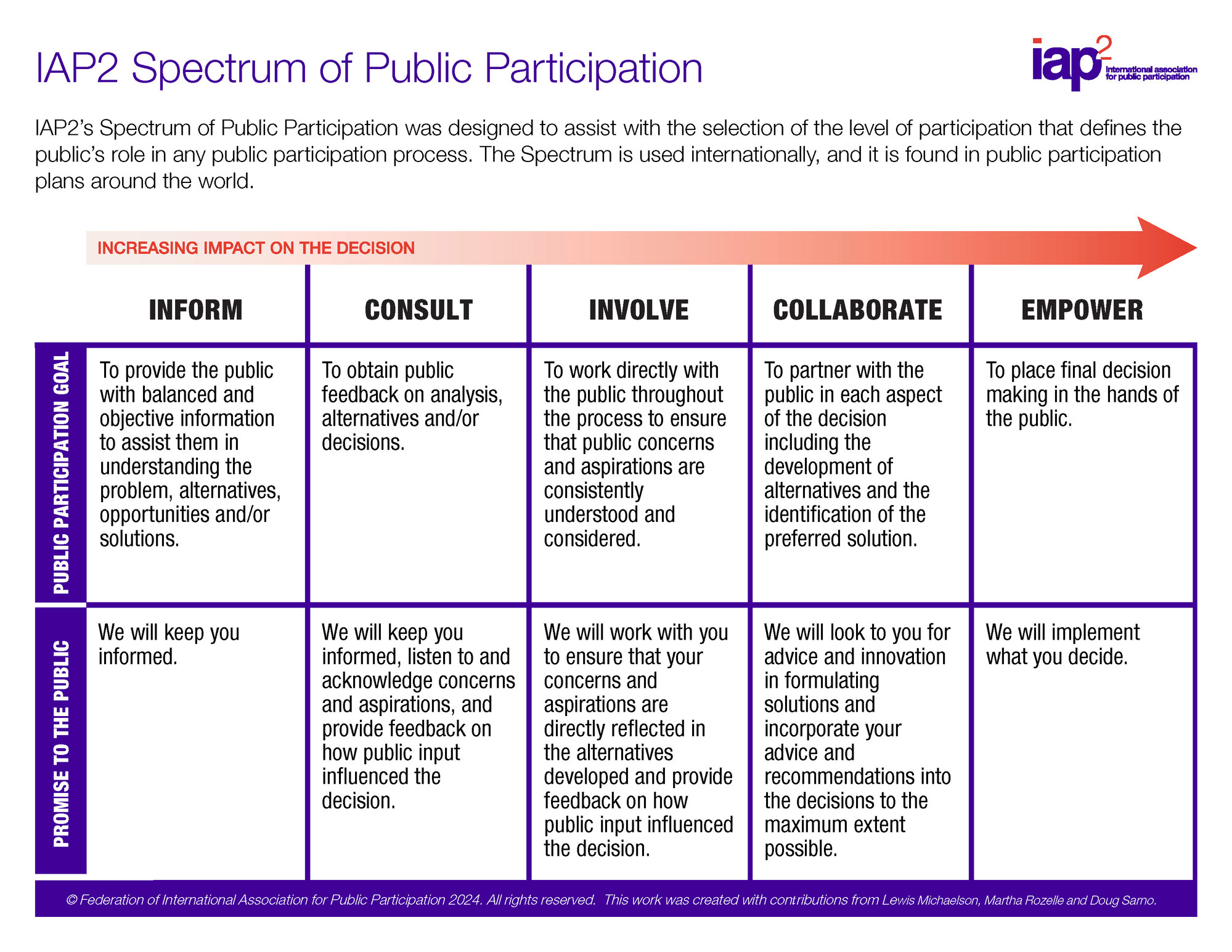
This project uses the International Association of Public Participation’s (IAP2) Spectrum of Public Participationโน to gauge levels of community engagement within health departments (Figure 1). The IAP2 spectrum helps organizations evaluate the extent to which community members, residents, and organizations are involved in decision making, ranging from one-way information sharing (“Inform”) to collaboration and community empowerment. While engagement (“Consult”) can strengthen communication and responsiveness, it does not necessarily shift decision-making authority. Community power building enhances basic engagement by intentionally prioritizing shared decision making and increasing community influence over priorities, resources, and outcomes.

Figure 1. Image used with permission from the Institute for Public Participation.ยฉ Federation of International Association for Public Participation 2024. All rights reserved. This work was created with contributions from Lewis Michaelson, Martha Rozelle, and Doug Sarno. www.iap2.org

As shown in the IAP2 spectrum, there is a wide range of possible engagement with residents in a community. Many local health departments fall between “Consult” and “Collaborate” (Figure 1). According to the 2024 Public Health Workforce Interests and Needs Survey, 74.8% of all local health departments prioritize input from community members.ยนโฐ

Local health departments are charged with improving the health of entire jurisdictions, including the many diverse communities within them, through creating structures, services, and offerings designed with community members at the center. This makes them well suited to integrate community power building into their ongoing work, or, using the IAP2 spectrum, move their work toward “Collaborate” and “Empower.”

For example, many health departments are required to conduct Community Health Assessments (CHAs) to determine a community’s health status based on factors such as chronic disease, births, and access to healthcare. The CHA process often includes key informant interviews that, with quantitative data, unearth a community’s needs. The results of the CHA then inform a Community Health Improvement Plan (CHIP) to address those needs. Throughout the CHA and CHIP process, health organizations engage local partners and residents to gather information, set priorities, and develop action plans. Done well, this process can fall within the “Involve” and “Collaborate” categories on the IAP2 spectrum.

Another example of work in the “Collaborate” category comes from Denver, Colorado, where city officials partnered with community leaders, the local housing authority, housing advocates, and, most importantly, renters, to address the need for healthy and affordable housing. Renters, who are most likely to be affected by housing policies, were positioned as partners in identifying needs and pathways to address shortcomings in local housing. This work culminated in an affordable housing trust that supports programs and services promoting housing stability for both renters and homeowners.

Building power through supporting community organizing and base-building is foundational to begin to address the root causes of inequities and to improve health, equity, and racial justice outcomes.
โ€“ The Praxis Project

Similarly, community members partnered with county officials in King County, Washington, to co-design a plan to equitably allocate resources to mitigate the compounding harms of the COVID-19 pandemic and structural racism. Through their participation, residents influenced both the budgeting cycle and processes and created a long-term vision for county governance.

A more rural and politically conservative jurisdiction that has embraced community power building efforts is Linn County, Iowa. In late 2024, Linn County successfully launched the Landlord Tenant Success Initiative, a pilot incentive program developed by the Alliance for Equitable Housing that aims to improve landlord-tenant relationships. In particular, Linn County secured funding to create the Persons with Lived Experience Advisory Council, through which people experiencing homelessness will inform programming.

When the people most affected by systemic barriers are involved in designing solutions to inequities, they can help to identify problems and shape adequate responses. Research shows that this approach tends to benefit everyone in a neighborhood, including residents who already have access to resources or strong safety nets.ยนยน,ยนยฒ


At the national level, the de Beaumont Foundation, along with several national and local funders, has supported community power-building work through The BUILD Health Challenge (BUILD) initiative. By investing in multi-sector and community-centered partnerships, BUILD transforms systems and champions community power building to advance public health goals across the United States.ยนยณ Drawing from lessons learned from over a decade of work among BUILD communities, tools like the Community Health Workbook build trust and relationships across sectors.ยนโด

Several community power-building efforts in public health and within health departments are based on Health in Partnerships’ (HiP) work. HiP has an extensive history of supporting and amplifying community power building to address long-range population health challenges. Their framework, approach, and tools support local public health practitioners seeking to embed community power building and equity into their work. HiP’s cohort-based program, Power Building Partnerships for Health, deepens relationships, trust, and structures for local health departments and community power-building organizations to take collective action toward health equity and racial justice.ยนโต

National investments to support local power building are critical. Many local communities are under-resourced, which limits their ability to effectively build and sustain power efforts. Initiatives are often done in spurts and starts, losing momentum when support is most needed. National investments not only serve to complement these local efforts but can also catalyze them. When local communities have greater access to resources, opportunities for change emerge.


Purpose

While community power building is gaining traction across public health and is increasingly recognized as a critical approach, much of the attention and investment has focused on higher-resourced or metropolitan areas. Rural health departments, particularly those in conservative jurisdictions, are often overlooked despite their long history of navigating complex political, social, and capacity constraints that require strategies grounded in trust, shared leadership, and community representation.

To better understand current community power building efforts in rural areas, the de Beaumont Foundation conducted 10 virtual focus groups between March and August 2025 with 14 public health professionals working in small or rural local health departments.

Four key questions guided this exploration of what is and is not working in the field:

  • How do local health department staff in rural areas approach community power building?
  • What are the opportunities and challenges for community power building in these areas?
  • How have local health department staff in rural areas succeeded in community power-building efforts?
  • What do local health departments in rural jurisdictions need to grow and sustain their community power-building efforts?

The focus groups explored a range of themes, including:

  • Definitions and level-setting (e.g., “How do you define ‘community power’ from your perspective?”)
  • Successes and challenges (e.g., “What strategies have been most effective in building relationships and trust within the community?”)
  • Expanding impact and future possibilities (e.g., “What supports are needed to advance your power building work?”)

This report highlights findings from the focus groups, including the challenges and opportunities shaping rural health departments’ ability to engage in community power building. It also presents concrete examples of rural communities collaborating with residents and offers practical next steps for departments and staff to begin and sustain this work.

Focusing on Rural Public Health Departments

Rural areas present a distinct opportunity to advance health equity through community power building. Many rural jurisdictions are anchored by social assets such as close-knit community ties, which are critical to community power building. At the same time, rural areas face real constraints. Geographical barriers can make consistent in-person engagement difficult, requiring residents to overcome physical distance to build and sustain relationships as individuals and institutions.

Why Rural?

This work focused on rural communities due to their unique assets, such as close-knit communities, and distinct challenges, including large geographic distances.

These challenges are compounded by the growing politicization of public health. In the current political climate, more politically conservative communities are pushing back against public health guidance, seeing it at odds with their worldviews.ยนโถ This dynamic creates a form of psychological distancing between communities and rural health departments, creating a lack of trust and less meaningful engagement between the two.

This dynamic can create a paradox for rural public health agencies. Agency staff are deeply embedded in the communities they serve, often sharing similar social networks, relationships, and histories. Yet, at the same time, they must navigate political pressures, limited resources, and increased polarization while trying to maintain and grow their community relationships. In this context, community power building becomes a critical tool to address these challenges. It offers a practical pathway to rebuild trust and shift public health policies and practices toward what residents identify as most important.

For the purposes of this report, rural communities include “areas outside of metropolitan (urban) areas, which may mean small towns, Tribal lands, frontier or remote areas that are geographically isolated.”ยนโท


Findings

About the Research


Focus group participants represented public health practitioners and community partners across rural jurisdictions in the Midwest, Northeast, Pacific Northwest, Pacific territories, and South. Participants worked on a wide array of public health issues, including food security, housing, family health, behavioral health, overdose response, sexual health, and both infectious and non-communicable disease prevention. Many staff worked at the intersection of these issue areas.

Most participants served vast geographic regions, sometimes covering up to 10 counties characterized by small, dispersed populations and strong local neighborhood ties. Many jurisdictions included agricultural areas or communities where residents lived far from basic services. Despite limited resources, participants shared a deep commitment to relationship building and to using local assets to improve community health.

Participants were not directly asked about their jurisdictions’ political leanings. However, upon further examination, 11 of the 14 participants worked in conservative, Republican-leaning communities. This context is critical in understanding the specific efforts participants took to build and sustain community power.

During the focus groups, participants reflected on their own level of community involvement using the IAP2 Spectrum of Public Participationยนโธ (Figure 1). They positioned themselves across the spectrum, with most landing in the middle categories of “Consult,” “Involve,” or “Collaborate,” yet nearly all voiced a clear aspiration to move toward the “Empower” stage, where communities drive decisions rather than simply inform them.

We want to reach people wherever, because transportation is obviously a huge barrier. So we got a mobile unit with the Ryan White clinic through the Ryan White clinic fundsโ€ฆ[W]e take that out to food pantries, soup kitchens, different places where we know that peopleโ€ฆneed those services.
– Focus Group Participant

When describing what community power building means in their work, participants spoke passionately about strong partnerships, amplifying residents’ voices, sharing decision-making power, and reexamining who sits at the table. They emphasized the need to center people with lived experience in public health efforts and to have their stories inform public health strategies and solutions. Many participants also underscored the role of information access as a form of power in itself, enabling communities to act with confidence and self-determination.

Your agency is not the know-all, end-all. It’s sharing that information and that power with the outside entities so that they can take on that role as well.
– Focus Group Participant

Community Connections

Trust, presence, familiarity, and clear communication are necessary to develop and sustain strong relationships between local health department staff and community members. Community power building depends on these foundational elements and requires reciprocity, allowing health department staff to be seen as partners rather than distant regulatory authorities.

Across focus groups, participants emphasized that trust is the foundation of effective community-engaged work; everything else grows from it. Trust takes time and consistency, and is built through transparency, mutual respect, and accountability. Participants described building trust by explaining decisions clearly, prioritizing community members’ consent, acknowledging people’s contributions to the work, and avoiding showing up with a fixed agenda. These practices signal openness and humility on the part of health departments, demonstrating that community voices truly matter and that relationships are valued over specific outcomes.

Participants also spoke about presence: the power of simply showing up at community events or visiting community partners, choosing phone calls over less-personal emails, and being visible beyond formal engagements. This kind of steady presence deepens credibility and positions public health partners as part of the community, not observers. Presence also solidifies public health entities as a reliable, consistent source of information, assistance, and partnership.

Also highlighted in the focus groups were the roles of familiarity and communication in building and sustaining trust. Many participants came from the same regions or shared lived experiences with the communities they served, allowing for a more authentic understanding of local opportunities or challenges. This common understanding helps health department staff tailor how messages are delivered, what asks are made of community members, and which public health services are offered.

Moreover, participants emphasized that communication must be locally grounded and consistent. Some focus group participants emphasized that, in their rural area, information spreads best through word of mouth, and that solid relationships are formed at face-to-face gatherings, which are, in turn, sustained through virtual platforms.

โ€ฆTrying to understand who we’re serving, who we’re talking to, and trying to get that temperature, and modifying, sometimes my delivery on things. Modifying maybe what I’ll say, how I’ll explain it, different means of explaining itโ€ฆ[my father is] low literacy, so giving him a bunch of print material wouldn’t be helpful, so maybe talking it out [instead].
– Focus Group Participant

Strategy

Community power building is sustained through strong relationships among residents and diverse partners. Yet rigid agendas and predetermined strategies prevent the flexibility needed to work effectively with residents. Moving toward the “Empower” category in the IAP2 spectrum requires an approach that is less about rigid plans and more about knowing when and how to move, with whom, and toward what shared purpose. Participants noted that effective strategies are grounded in relationships and adapted to local realities.

Partnerships emerged as a central tenet of community-based work in rural communities. Participants emphasized the importance of knowing local employers, businesses, nonprofits, and community leaders personally and being able to connect with them directly. Building partnerships on shared goals, such as asking, “What can we agree on?” helps align efforts around a common vision for the community. This approach not only clarifies priorities but also strengthens collaboration across sectors that may not traditionally work together.

We have a gentleman who has done so much work with us, [who is a] proud National Rifle Associationย (NRA) member, and he absolutely understands that our mission is to keep people safe, and he’s so on board with it, and he’s probably so different politically or personally with some other people in our alliance. But when we drill down to, ‘What do we agree on, like safety,’ he can see that we want safety and he wants safety, and so it just makes a really good fit.
– Focus Group Participant

Effective partnerships also depend on the health department serving as a neutral convener focused on collective benefit rather than its own agenda. Several participants noted that each partner comes to the table with their own specific needs and agendas, but persistence and openness can reveal common priorities. Recognizing smaller, overlooked organizations as valuable allies was also noted as key for inclusive collaboration.

Openness and flexibility, too, are vital for building and sustaining partnerships. Asking partners, “What works best for you?” and being willing to play a neutral or backbone role can defuse territorialism. Flexibility in organizational approaches to partnerships, including sharing resources, also helps them be more sustainable and nimbler.

In addition to being a trust-building tool, strong communication with multi-sector partners was identified as a crucial element of institutional strategy. Participants discussed the importance of translating public health impact into language that resonates with different audiences, such as demonstrating a return on investment or showing how initiatives contribute to the local economy when speaking to policymakers. Some participants also highlighted staying apolitical to ensure that messages remain accessible and resonant in polarized environments.

Finally, participants underscored that effective strategies depend on institutional support. Flexible structures, supportive leadership, and adaptive funding mechanisms allow practitioners to seize opportunities and sustain momentum. When organizations back their teams with this kind of flexibility and support, staff can respond strategically to community needs as they evolve.

Really encouraging [power sharing] from an agency perspective has led us in a lot of directions that we would have really not been aware that we needed to pursue, and also has created a lot of tangible solutions that are much more cost-effective.
– Focus Group Participant

Although rural jurisdictions have many assets for community power-building efforts, they also grapple with roadblocks. Recognizing and exploring these challenges is necessary to address them effectively.

Internal Tensions: Capacity, Bureaucracy, and Institutional Rigidity

Capacity

Many barriers stemmed from inside public health departments themselves. Participants described chronic workforce shortages, burnout, and turnover, preventing innovation and relationship building. Staff morale has also suffered under the weight of public hostility, as seen during and after COVID, and administrative overload โ€” what one participant called “death by a thousand paper cuts.”

It was true [that] with COVID…we had to do…mask mandates [and] case investigations…I think we went from…flying like under the radar, like people were like, ‘Oh yeah, go to the health department to get like, you know, a water test kit or get your vaccines for your kids,’ and then all of a sudden it was just this huge national mistrust of public healthโ€ฆand with vaccines. And it was really, really…really hard. [Even] now…though I work in areas like car seat safety or…substance abuse or harm reduction or suicide prevention, so not necessarily in vaccines…I’m [still] under this umbrella [of public health]…It’s definitely been, I think, a huge challenge.
Bureaucracy

Compounding capacity challenges are the realities of government bureaucracy: layers of approvals, restrictive procurement rules, and institutional norms that discourage flexibility or community-driven approaches. As one participant stated, and several others agreed, there is “no policy directive to include community,” and lived experience is often discounted in decision making.

Institutional Rigidity

Even when staff have the will and funding to compensate community members for their participation, there is still the issue of finding a payment mechanism that abides by institutional policy, is logistically feasible, and does not create undue tax burdens on the residents. Public health often turns to gift cards as a compensation mechanism, but they may not reflect what communities value as “payment” and come with their own complications.

Together, these internal dynamics create unnecessary roadblocks in systems that struggle to adapt to community needs.


Tensions with External Partners and Power Structures

Participants also described friction in working across sectors, especially when power and control were unequally distributed. Partnerships had faltered due to ego, bias, and lack of clarity about roles. Others cited fragmented governance โ€” state, county, and local entities with overlapping authority โ€” as a persistent bottleneck.

Even when partnerships were well intentioned, conflicting mandates and funding rules made alignment difficult. Local public health departments often had to navigate siloed funding streams and misaligned priorities between government levels, leaving them with “very little that fits in the Venn diagram of what we’re actually allowed to do,” according to one participant.


Tensions with Community: Trust, Distance, and Historical Harm

Building trusting relationships with community members is an ongoing goal. Participants acknowledged that many residents view public health as bureaucratic, transactional, or disconnected from lived experience, and some health departments have taken years to break down these relational challenges. Building relationships in rural areas is further complicated by geography; health departments may span multiple counties, with limited staff and long travel times.

Building trust is a critical and ongoing process for many local health departments.

Communities’ skepticism is often rooted in history. As one participant put it, public health initiatives “came and went” or the public health department made promises without follow-through, thereby eroding trust over time. In the same way that regular, transparent communication helps build trust, participants stressed that inconsistent engagement erodes it, and that genuine partnership requires sustained presence.


Political and Social Tensions: Climate, Perception, and Safety

Finally, participants described working within a politically charged environment where public health has become polarized. Local leaders and residents in some areas resist government involvement or reject concepts like equity and inclusion. In certain jurisdictions, staff said they cannot use terms like “health equity,” “diversity,” or “inclusion” without fear of backlash.

Because social determinants of health are often driven by policy, public health is inherently political. Navigating changing political climates is often a challenge for local public health efforts.

This politicization has constrained communication, discouraged risk taking, and sometimes endangered staff or partners who champion equity work. Participants noted that navigating this climate requires diplomacy, persistence, and institutional backing, which are not always possible.


Needs: Infrastructure Supports

Participants painted a clear picture of what it takes to sustain community power building in rural public health: steady resources, skilled people, supportive systems, and the practical means to stay connected. They described the daily challenge of doing deep community work without enough time, staff, or funding, and how easily these internal strains can erode trust and momentum. They called for investments that allow communities to set their own priorities, funders who value relationships as much as results, and agencies that are equipped and encouraged to work alongside residents as partners, not just on their behalf.

Beyond funding, participants emphasized the need for training and leadership buy-in to help staff navigate complexity, bridge political divides, and keep the focus on shared goals. They also underscored the importance of, and desire for, supportive policies and institutional practices that prioritize community participation. Finally, they spoke to the practical realities of rural life and the need for infrastructure that makes engagement possible, from mobile outreach and broadband access to partnerships that can open doors and reduce bureaucratic barriers for residents.

Ultimately, participants’ vision is one of sustainable partnership. Community power building flourishes when local agencies are resourced to listen deeply, share decision-making power, and create space for communities to lead. Focus group members expressed a need for conditions that allow public health and the communities they serve to move forward together with trust and shared purpose.


Conclusion

Summary


The findings show that community power building is seen as a strategic approach for rural public health departments to better address community needs. The emphasis on relationships reflects both necessity and opportunity. In rural areas, where public health staff are often long-term neighbors or generational residents, these relationships enable effective interventions and sustained communication across large distances and with limited resources.

Focus groups also revealed that rural public health departments face significant barriers to effective community power-building work, including political polarization, unstable funding, staff shortages, and large service areas. Rural dynamics also complicate engagement. Small populations and overlapping networks mean that public health actions are highly visible and political tensions can arise quickly, even regarding national or state-specific politics. Limited staff capacity often forces departments to prioritize immediate needs over long-term engagement, reinforcing a pattern of involving communities only during crises. Without intentional structures to shift power, departments may have limited engagement and miss the full benefits of community leadership.

Despite these obstacles, public health practitioners and community partners highlighted the strength of local relationships and their deep commitment to public health. Trust, consistent presence, transparency, and shared lived experience are essential for effective community engagement. Participants noted that rural contexts โ€” characterized by smaller or dispersed populations, overlapping networks, and informal communication โ€” can both facilitate and complicate public health efforts. Many expressed a desire to move from “Involvement” to “Empower” on the IAP2 spectrum but underscored that this shift requires internal and structural support, which most rural health departments currently lack.

Participants’ interest in community power building highlights a broader understanding: Rural health departments see deeper partnerships as essential to addressing inequities, particularly for communities historically excluded from decision making. They recognize that community power building strengthens public health departments’ ability to navigate political divides, rebuild trust, and advance equity. However, they require time, staffing, cultural alignment, and institutional support to make this shift sustainable.

Participants seemed to largely agree that centering the people most impacted by public health disparities is an effective way to advance the mission of public health, whether or not words like “equity” are used. Their insights reflect a practical approach rather than a distinctly political one. They demonstrate that public health becomes stronger, more capable, and more trusted when decision making is shared with the communities it exists to serve.

Core Principles for Public Health Practice

Several core principles for public health practice emerged from the findings, specifically for rural government public health agencies and their staff:

  • Relationship infrastructure is a core public health capacity. For rural departments, trust, presence, and communication are foundational to nearly every public health function.
  • Embedding community power building enhances resilience. Rural departments that invest in shared decision-making structures are better positioned to weather crises, turnover, and political pressure.
  • Health equity practices require structural change and institutional support. As a practice, advancing equity in rural areas is limited when engagement relies on familiar networks, or when political or funding pressures discourage outreach to communities facing the greatest inequities. Intentional power-sharing goals need to be built into systems for effective implementation.
  • Informal communication is both an asset and a risk. Word of mouth and closed networks spread information quickly but can also amplify misinformation or backlash. Community-rooted partners are essential for navigating these dynamics.
  • Rural context is not a barrier but a defining feature. Geographic spread, limited resources, and close relationships shape both the challenges and opportunities for power building in rural public health.

Together, these core principles show that sustaining community power building in rural settings requires more than individual effort. It demands organizational commitment and broader systems that enable full community participation in shaping relevant policies, practices, and strategies.


Calls to Action for Rural Public Health Agencies

These calls to action are based on learnings from this research and de Beaumont’s existing work in community power building, including The BUILD Health Challenge. The aim of these recommendations is to support rural local health departments, including but not limited to those in politically conservative jurisdictions, seeking tangible next steps to begin or deepen their community power-building efforts. Although health departments are encouraged to pursue all of these recommendations, implementing even one item from this list helps shift power to the community and, in the long term, improve population health.

  • Invest in long-term relationship infrastructure. Allocate time, staffing, and flexible funding to maintain a consistent presence, build trust, and facilitate communication across dispersed regions. Because resources are often limited in rural settings, public health leaders should anticipate these challenges and plan accordingly. They may begin by leveraging existing community meetings, volunteer networks, and social media channels to strengthen relationships without substantial initial investments. These incremental steps can lay the groundwork for a robust support system while also ensuring that resource limitations are acknowledged and proactively addressed in strategy development.
  • Create durable structures for shared decision making. Establish advisory bodies, leadership roles, or co-governance models that elevate community authority beyond crisis moments. One example of a practical tool comes from The BUILD Health Challenge Community Health Workbook, which provides a step-by-step guide to fostering community-centered cross-sector partnerships.
  • Support internal cultural shifts within rural government agencies. Equip staff with tools and training that normalize power sharing and align organizational culture with participatory approaches.
  • Provide government agencies and engaged community members training in conflict resolution and facilitation skills. Address the political diversity prevalent in rural areas. Align on shared interests and values to effectively activate engagement and progress on collective goals.
  • Intentionally prioritize communities most harmed by health disparities. Develop strategies that reach those most affected by inequities rather than relying solely on familiar partners or low-conflict networks.
  • Leverage rural residents’ voices and expertise as assets for successful public health interventions. Use local knowledge, overlapping networks, and trusted messengers to extend engagement, reinforce accurate information, and deepen accountability.
  • Shift the language used to describe community power building and community engagement. Use language that resonates with the local community and find ways to soften “equity-centric” language in increasingly politicized rural spaces. For example, instead of saying, “We want to shift power to the community,” say, “We want to amplify residents’ voices.”
  • Organizations should provide community members a range of compensation options, from cash and flexible payment methods to in-kind supports. Community members should be equitably compensated for their time and expertise. If funding is a constraint, explore options like meals, transportation, and childcare, and clearly communicate these choices so that participants can select what works best for them.

By intentionally embedding community power building, rural public health departments can rebuild trust, stabilize their operations, and advance equity in alignment with the strengths and realities of their communities. Implementing the recommended strategies provides concrete pathways for departments to improve health outcomes.


Endnotes
  1. Michener, J. L., Williams, A., Kent, D.-O., & Aguilar-Gaxiola, S. A. (2025, June 25). Community engagement: A Foundation for Health Equity and Resilience. American Journal of Public Health, 115(S2). https://ajph.aphapublications.org/doi/10.2105/AJPH.2025.308029
  2. Building Community Power for Health, Justice, & Racial Equity. (2022, June 14). The Praxis Project. https://www.thepraxisproject.org/building-power
  3. The Foundational Public Health Services – Public Health Accreditation Board. (n.d.). https://phaboard.org/infrastructure/public-health-frameworks/the-foundational-public-health-services/
  4. Centers for Disease Control and Prevention. (2024, May 16). 10 essential public health services. Public Health Professionals Gateway. https://www.cdc.gov/public-health-gateway/php/about/index.html
  5. Parker, K. (2018, May 22). How urban, suburban and rural residents’ view social and political issues. Pew Research Center’s Social & Demographic Trends Project. https://www.pewresearch.org/social-trends/2018/05/22/urban-suburban-and-rural-residents-views-on-key-social-and-political-issues/
  6. Gimpel, J. G., Lovin, N., Moy, B., & Reeves, A. (2020). The Urbanโ€“Rural Gulf in American Political Behavior. Political Behavior, 42. https://doi.org/10.1007/s11109-020-09601-w
  7. Iton, A., Ross, R. K., & Tamber, P. S. (2022, December 5). Building community power to dismantle policy based structural inequity in Population Health. Health Affairs Journal. https://www.healthaffairs.org/doi/10.1377/hlthaff.2022.00540
  8. Building Community Power for Health, Justice, & Racial Equity. (2022, June 14). The Praxis Project. https://www.thepraxisproject.org/building-power
  9. Michaelson, L., Rozelle, M., & Sarno, D. (2024). IAP2 Spectrum of Public Participation. International Association of Public Participation. https://www.iap2.org/resource/resmgr/pillars/iap2_spectrum_2024.pdf
  10. de Beaumont Foundation and Association of State and Territorial Health Officials, Public Health Workforce Interests and Needs Survey Data Dashboard. July 2025.
  11. Vaidya, A., Poo, A., & Brown, L. (2022). Why Community Power Is Fundamental to Advancing Racial and Health Equity. NAM Perspectives, 6. https://nam.edu/perspectives/why-community-power-is-fundamental-to-advancing-racial-and-health-equity/
  12. Saleheen, H. N., & Barela, K. A. (2025). Community Power Model: Pathway to Equity. Journal of the National Hispanic Medical Association, 3(1), 83โ€“104. https://doi.org/10.59867/001c.137833
  13. From Vision to Impact: Ten Years of Building Together – BUILD Health Challenge. (2025, June 4). BUILD Health Challenge. https://buildhealthchallenge.org/resources/ten-years-of-building-together/
  14. The BUILD Health Challenge Community Health Workbook – BUILD Health Challenge. (2023, June 12). BUILD Health Challenge. https://buildhealthchallenge.org/resources/workbook/
  15. Health In Partnership | Power Building Partnerships for Health Program. (2024). Healthinpartnership.org. https://www.healthinpartnership.org/programs/power-building-partnerships-for-health
  16. Lister, J. J., & Joudrey, P. J. (2022). Rural mistrust of public health interventions in the United States: A call for taking the long view to improve adoption. The Journal of Rural Health, 39(1). https://doi.org/10.1111/jrh.12684
  17. Rural Public Health Strategic Plan. (n.d.). CDC. https://www.cdc.gov/rural-health/media/pdfs/2024/08/cdc-rural-public-health-strategic-plan-8-29-24-508-final.pdf
  18. Michaelson, L., Rozelle, M., & Sarno, D. (2024). IAP2 Spectrum of Public Participation. International Association of Public Participation. https://www.iap2.org/resource/resmgr/pillars/iap2_spectrum_2024.pdf