A toolkit for making the most of your time with policymakers and their staff.

  • Audience insights that explain the current “trust gap”. Learn More
  • A message formula for communicating with policymakers. Learn More
  • Examples of public health initiatives that show the value of the field. Learn More
  • Message “do’s” and “don’ts”. Learn More
  • Recommendations for enlisting credible messengers. Learn More
  • Tips for engaging with policymakers. Learn More

Posted on: December 8, 2025


Toolkit Background

Foreword: A Series of Toolkits for Communicating About Public Health

Effective public health practice starts with effective communication. Every policy, decision, and investment in public health directly affects people’s daily lives — from the water that flows from our taps, to the safety of our neighborhoods, to the opportunities we have to live full and healthy lives.

And yet, too often, public health is seen only as — and indeed, often positions itself as — an invisible force that prevents crises rather than a proactive force that creates well-being, prosperity, and possibility. To help change that perception, the de Beaumont Foundation launched Communicating About Public Health: A Toolkit for Public Health Professionals in February 2025. That first toolkit introduced five simple but powerful messages to help professionals explain what public health is and why it matters in ways that resonate with people’s everyday experiences. It also carried an important truth: every public health professional, no matter their role, is a communicator and an ambassador for the field.

This new toolkit builds on that foundation. It focuses on one audience whose understanding and partnership are essential for progress: policymakers. Public health cannot meet today’s challenges alone. Whether it’s strengthening our workforce, improving community health, or addressing inequities, success depends on collaboration — and collaboration begins with conversation.

We hope this resource helps you start those conversations with confidence and clarity. Inside, you’ll find research insights, tested messages, and practical tips to make your communication with policymakers more effective and impactful.

Because at the end of the day, advancing public health isn’t just about the programs we run — it’s about the stories we tell, the relationships we build, and the shared belief that healthier communities are possible when we work together.

This toolkit was developed to help public health professionals communicate more effectively with policymakers.

Public health professionals must communicate effectively with policymakers because they are the decision-makers who allocate resources, set priorities, and create the policies that determine community health outcomes. State and local policymakers are particularly influential in these areas.

But communicating about public health with policymakers is challenging for several reasons. Often, the tangible benefits of public health investments — which tend to be long term and preventive — can feel “invisible” to policymakers who are looking for short term wins. The current climate provides even more challenges: Previously common-sense public health efforts have become politicized, polarized, and fraught with misinformation.

And as you’ll see from the research findings in the toolkit, many policymakers believe that public health professionals could be more strategic during their interactions — showing that they understand the many competing demands policymakers have to consider, understanding their interests and constituents, and framing their advocacy accordingly.

To help overcome these challenges, this toolkit includes practical guidance that can help you explain important issues to policymakers and motivate them to support policy solutions. In this toolkit, you will find:

  • Audience insights that explain the current “trust gap”
  • A message formula for communicating with policymakers
  • Examples of public health initiatives that show the value of the field
  • Message “do’s” and “don’ts”
  • Recommendations for enlisting credible messengers
  • Tips for engaging with policymakers

As noted in the methodology section below, the de Beaumont Foundation sponsored focus groups with policy insiders — former elected officials and senior aides at the state and local level — across the political spectrum to inform this toolkit. As expected, some were very supportive of public health policies, while some were very skeptical. The recommendations in this toolkit are designed to be most effective for communicating with policymakers who are skeptical.

This toolkit is designed for public health professionals who engage with policymakers — or aspire to do so with greater confidence and impact. It’s for advocates, leaders, and practitioners who want to make the most of their time with decision-makers, whether in conversations with city council members, county commissioners, state legislators, or their staff.

The recommendations in this toolkit were based on an extensive round of research with policy insiders at the state and local level across the United States.

We conducted five focus groups (total n=20) with policy insiders from politically competitive “purple” states (Minnesota, Nevada, Michigan, Ohio, North Carolina, Pennsylvania, Wisconsin, Georgia) from August 12 to 14, 2025.

Focus groups included former elected officials and former senior aides (e.g., chiefs of staff and legislative directors) at both the state and local levels.

We conducted two focus groups with Democrats, two with moderate Republicans, and one with conservative Republicans aligned with the MAGA movement. MAGA policy insiders were categorized based on their support for the direction the Republican party has taken since 2016, the issues they want the party to prioritize (e.g., “putting America first and securing the border,” vs. “supporting free trade and economic growth”), and their view of U.S. involvement in international alliances (e.g., NATO). Two of the groups included policy insiders with backgrounds in the sectors that public health most often collaborates with, such as housing, transportation, or education.

The focus groups were held via Discuss.io and explored participants’ perceptions of public health and their concerns or questions about supporting public health policy efforts. In each group, we also tested a range of messages to explore the most effective way to motivate policymakers to support public health policy efforts in the context of their roles.


image

Why Communicating with Policymakers Matters

Policies determine the conditions that shape community health — from budgets and resource allocation to laws that influence safety, housing, and education. For public health professionals, communicating effectively with policymakers is essential to ensure the best ideas and evidence translate into action.

Understanding the Trust Gap — and How to Bridge It

The greatest barrier to engaging skeptical policymakers is a lack of trust in public health professionals.

For many, distrust leads to immediate doubt or dismissal of public health messages — making it hard to break through. Use the strategies below to overcome common trust barriers and motivate policymakers to prioritize and advance public health in their work.

For many policymakers who distrust the public health field, their first instinct is to doubt or question what public health professionals say – which makes it very difficult to break through to them.

We identified three key perceptions that fuel this distrust.

1. Public health is seen as a zero-sum game
What it means

Policy insiders see public health as a zero-sum game. They think public health professionals bring them problems that require difficult or unfeasible tradeoffs in budgeting, policy, or lifestyle choices.

Why it matters

As a result, policymakers become demotivated to prioritize public health in their decision-making. They think of public health as a constant tug-of-war that requires sacrifices without obvious payoffs. Because of their focus on the costs of solving “problems,” they aren’t able to see the positive, aspirational goals that public health policies can achieve.


Feedback from policy insiders
Most public health officials are trying to be honest within their worldview, but they have a very specific lens. Shutting down all the schools may seem like the best response from a public health perspective, but it can create externalities that affect social well-being. Even if officials give their best advice, it’s important for decision-makers to weigh it in the larger context of society.
– Republican, Purple State
To take an extreme example, we might all be healthier if we got rid of every car, but it would have a drastic effect on society. Fewer people would die because there are no car crashes, and people would be healthier because they’re walking everywhere. However, the cost to society of that sort of decision probably doesn’t outweigh the benefits.
– Republican, Purple State
What it means

Policy insiders—especially Republicans—perceive public health professionals as driven more by a political agenda and an ideology than practicality. They believe public health professionals will always push the most restrictive or far-reaching policies, even if the evidence doesn’t fully justify it. And (related to their “zero-sum” concerns) they doubt that public health professionals weigh the real-world impact on people’s lives, businesses, or competing policy priorities.

Why it matters

As a result, many policymakers automatically assume public health recommendations are inherently extreme. Rather than evaluating recommendations on their merits, they instinctively seek out opposing viewpoints, which undermines credibility and influence of the public health field.


Feedback from policy insiders
[Public health] focuses only on the public health effect without addressing the broader societal questions—like what it costs to reduce air pollution. To me, that makes it feel more political than prescriptive or helpful.
– Republican, Purple State
In the state I live in, they want to get rid of cadmium in keys. It’s come to the point where now keys can’t be sold in the state because no manufacturer can produce them…. And for what point? The actual effect on public health is so nil. Now, whenever the extension period comes around, it becomes a total waste of time—the legislature has to debate extending it again because they can’t just rescind the measure that prohibited it in the first place. … Sometimes things become so ideologically driven that they just get passed to get them out of the way.
– Republican, Purple State
What it means

Policy insiders—especially Republicans—believe public health undervalues personal responsibility to health. They see the field as favoring mandates and regulations over empowering people with information and tools so they can make their own choices.

Why it matters

This perception reinforces the idea that public health is out of touch with many Republican policymakers’ core values, such as individual freedom and personal responsibility. As a result, policymakers are less willing to support public health initiatives and instead assume there’s a less intrusive solution that prioritizes individual choice.


Feedback from policy insiders
I don’t want them to tell me as a government agency what I can and cannot eat… but I do want transparency to give me the information and let me make the decision for myself. I want as a consumer to be able to make my own choices, whether it’s what doctors I pick or what kind of drugs I take. I just want more transparency with the science and options.
– MAGA Republican, Purple State
Give me statistics on measles cases this year or flu outbreak rates. With that information, we can take care of ourselves—decide whether to get a flu shot, keep kids home during an outbreak, or update vaccinations.
– MAGA Republican, Purple State

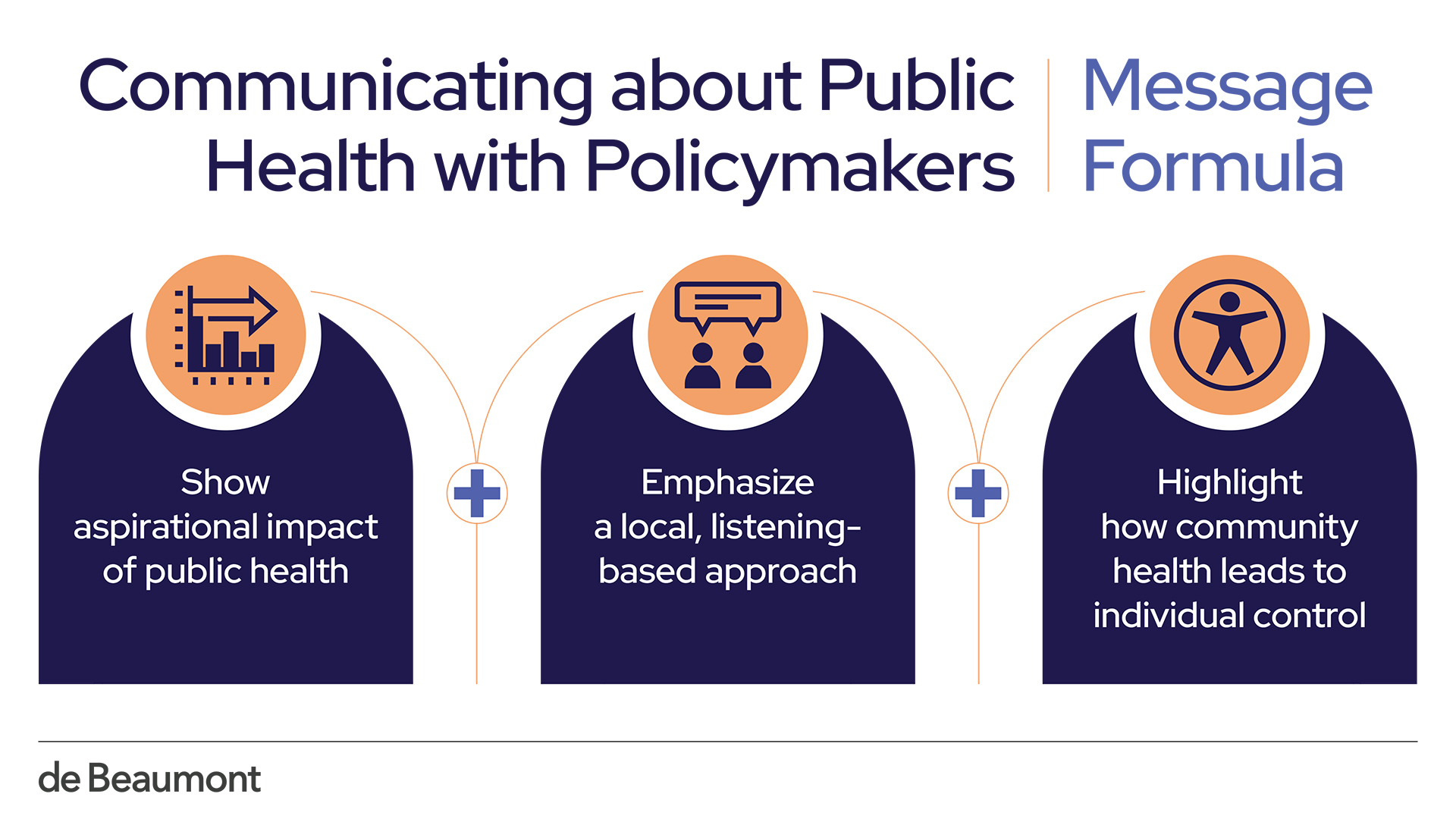
Message Formula for Communicating with Policymakers

We identified three key framing strategies for communicating with policymakers. Messages grounded in these approaches are most likely to be effective at:

  • Closing the trust gap between policymakers and public health professionals
  • Overcoming the specific barriers listed in the previous section
  • Motivating policymakers to champion public health by offering a positive, solutions-oriented vision of what it can achieve

To accomplish this, messaging should:

Show aspirational impact Emphasize a local, listening-based approach Highlight how community health leads to individual control
Position public health as a force that strengthens both local well-being and economic vitality, rather than something that inherently requires a tough tradeoff. Show that public health recommendations are based on listening to communities about their needs – not on an ideological agenda. Demonstrate that community health and individual control are complementary: when communities are healthier, people have the ability to make healthier choices for themselves and their families.

Tips for Engaging with Policymakers

In addition to getting the message right, it’s also important that public health professionals prepare and strategize for policymaker meetings effectively. In our focus groups, policy insiders provided actionable guidance for how public health professionals can improve in that regard. More details can be found in the Appendix: “Tips for Engaging with Policymakers.”

Key Idea #1: Be aspirational about the impact of public health.
What it means

Position public health as a force that strengthens both local well-being and economic vitality, rather than something that inherently requires a tough tradeoff.

Why it helps policymaker communication

This reframing can break policymakers out of a zero-sum mindset. Rather than focusing on what it will cost to support public health, they can focus on the gains for their communities — both within and beyond what is traditionally considered health. Policymakers are more motivated to support initiatives that create visible community benefits, not ones that just fix problems.

This also relates to a key policymaker motivation: They are looking to establish a track record of accomplishments to help with re-election and to establish their legacy. As a result, it’s important to give them an optimistic view of what they can accomplish


Validation from policy insiders
[Cancer screenings, support during extreme weather, and prenatal care education] – those are very beneficial parts of people’s lives…Helping expecting mothers and infants and then providing cancer screenings. We at least all know someone who’s had cancer, and we want to make sure that other people can prevent it. I think it goes back to that personal impact of public health.
– Democrat, Purple State
[Public health] has so many different categories beyond health care systems and hospitals. It’s air quality, it’s water, it’s mental health, it’s so far-reaching.
– MAGA Republican, Purple State
More resilient communities….is a very persuasive summary of why public health is important, both from an economic and a health perspective.
– Democrat, Purple State

Thought starter: How would your community or state be different if policymakers implemented your top public health policy priority? Use vivid language to describe how it would change the community and people’s lives.

Example: If our city invests in building more walking and biking paths, everyone will benefit. People who walk or bike tend to stay healthier, which means fewer medical bills and less strain on hospitals. Local businesses along the paths will see more customers stopping by, which will boost the local economy. In neighborhoods with safe, well-lit paths, people feel more connected, kids will be able to get to school safely, and families will spend more time outdoors together. Over time, what starts as a health initiative will become a driver of economic growth and community pride.

What it means

Show that public health recommendations are grounded in listening to communities and responding to their real needs – not advancing an ideological agenda.

Why it helps policymaker communication

This reframing challenges the mindset that public health professionals are political actors imposing top-down directives from bureaucratic authorities. Instead, it shows that they are members of their communities who are listening to what the community needs and developing practical solutions to real problems


Validation from policy insiders
I liked that messaging that really focused on the community level. It feels less overarching, [less] like big government, and more just like helping at a granular local level.
–  Republican, Purple State
Local public health officials that live amongst us, whose kids go to school with our kids, and live next door to us have the most transparent voice and the most incentive to try to help their neighbors.
–  MAGA Republican, Purple State
I’d be more apt to trust a local public health official, especially if something happened in my community, or if I knew someone who knew them. There’s far less of a degree of separation than with a nameless, faceless expert on TV. If I’ve seen what a local official has done before on different issues, I’m much more likely to trust what they have to say because of that lower degree of separation.
–  MAGA Republican, Purple State

Thought starter: Think about a successful policy initiative you’ve been involved in, and explain how community input was part of the process. Cite credible, local messengers (e.g., doctors, nurses, first responders, law enforcement) who can back up the nature of the problem and the effectiveness of the solution.

Example: To combat teen vaping, we held listening sessions with teachers, school counselors, parents, and students. Teachers talked about how hard it was to spot vaping in classrooms. Parents said they wanted to help but didn’t know where to start. And students said most anti-vaping ads felt judgmental and out of touch.

With that input, the public health department helped design a program focused on prevention, support, and honest conversation. School nurses will lead support groups, students will shape campaign messages, and local clinics will offer free nicotine replacement therapy. Police and school resource officers backed the plan because it focuses on education – not punishment.


What it means

Policy insiders need to see that public health and individual choice can work hand in hand by creating environments that make healthy choices easier — like making workplaces safer, expanding healthy food options, and providing more opportunities for physical activity.

Why it helps policymaker communication

This framing helps policymakers realize they don’t have to choose between supporting a policy action and a philosophy of individual control.


Validation from policy insiders
Just like in education, what may be good for the masses may not be good for each individual, each family, each region of the country. Everybody has to make their own decision in consultation with their healthcare provider and with their families.
–  MAGA Republican, Purple State
I think that [public health officials] should release information and people should make their own decisions. You know, if they tell me at the local Walmart there was an outbreak, it’s not their place to tell me not to go there. It’s their place to tell me what happened if I choose to go there or not. That’s my choice. If I’m dumb enough to want to walk into something where I’m going to get sick, then that’s my fault. But I think it’s their job to provide information and to provide risk assessments, but not to say you can do this, or you can do that, or you can’t do this and you can’t do that.
–  MAGA Republican, Purple State

Thought starter: If successful, how would your work expand the options people have to make healthy choices? Can you frame your initiative as creating opportunity and empowerment, rather than limitation or restriction?

Example: When we support farmers’ markets in low-income neighborhoods, offer grocery store tax incentives, or fund school gardens, it’s not just changing what’s on the shelves. It’s giving people more real choices.*

For many families, eating healthy isn’t about knowing what’s good for them—they already know. The problem is access and affordability. When local policy makes fruits and vegetables easier to find and afford, it levels the playing field. Parents can pack better lunches, older adults can manage their diets, and kids can grow up seeing healthy food as a normal part of life.

How to Apply the Message Formula

Below is one example of how you can use the message formula to explain the overall mission of public health to a policymaker.

Using the Message Formula to Explain Public Health

Show aspirational impact: Help the audience see how public health strengthens entire communities.

Example: Public health is about more than hospitals or clinics — it’s about building more resilient communities, strengthening local economies, and helping people live longer, healthier lives. Imagine neighborhoods where children can walk to school without breathing polluted air, where transit systems boost local economies by connecting workers to jobs, and where seniors have safe, affordable housing that supports independence. That’s our goal.


Local & listening: Show how public health solutions are built from the bottom up and are shaped by listening to local community priorities.

Example: To find the best solutions to get us to that goal, we start by listening to people in the community who know best what they need. And then we work with local leaders to come up with solutions that are backed not just by data — but by the community itself.


Highlight how community health leads to individual control, so it’s clear these concepts are complementary – not contradictory.

Example: We know people want to make healthy choices for themselves and their families. Public health policies make it easier to do so — such as by providing safe spaces to exercise and access to fresh food. Together, community-driven policies and individual choices create healthier, more resilient communities for everyone.

Use the following thought-starter questions to describe what your organization does and how it impacts the community or state in which you work.

  • Show aspirational impact: If your organization’s work is successful, how would the community or state you work in be different? Try to describe benefits to people, communities, and businesses/economies.
  • Local & listening: How does your organization collaborate with and listen to members of the community? Try to include a range of parties, from individual community members to well-respected local leaders.
  • Highlight how community health leads to individual control: Explain how individuals would have more options or agency in their lives if your organization’s work were successful. This could include control over their health, economic situation, etc.

You can also use the message formula to craft messages about specific public health policies. Below is an example of how to use the formula to build support for making Narcan more widely available. This is just an example — not a script — and you can adapt the formula to the issues you work on in the exercise below.

Show aspirational impact: Show how Narcan isn’t just about solving a pressing problem — it’s about improving communities in the long term.

Example: Across our state, families and local leaders have been clear: they want safer neighborhoods, healthier families, and strong local economies. Preventing opioid overdoses is one of the most urgent steps toward that future.

Local and listening: Demonstrate how Narcan access comes from community demand, and cites a range of credible, local leaders to vouch for it.

Example: This isn’t just about responding to emergencies — it’s about listening to what families and local leaders have told us. Parents want reassurance that their kids are safe, first responders want tools to act quickly, and law enforcement want solutions grounded in compassion — not punishment. Narcan delivers on those priorities.

Conclude by showing how Narcan helps community members help each other — and gives the person who overdosed a chance to recover and thrive.

Example: Making Narcan widely available also empowers members of our community — neighbors, teachers, coworkers — to act quickly and help those they care about. It also means that more people who have misused opioids will have a second chance — and can take advantage of that chance knowing their community supports and believes in them.

Use the following thought-starter questions to try to motivate a policymaker to support one of your priorities.

  • Show aspirational impact: What vision do you have for your community’s future that this policy would help achieve?
  • Local & listening: How has this policy been shaped by listening to the community? How did the idea for this policy originate? What kinds of local leaders support it, and why?
  • Highlight how community health leads to individual control: If implemented, how would your policy proposals give individuals more opportunities to make healthy choices, or exert more agency in their lives?

Using Examples to Show the Value of Public Health

Helping policymakers understand the value of public health means giving them a more well-rounded view of what the field does. However, some examples are easier to communicate than others.

Use the categories below to pick the right examples to use in policymaker conversations. Use the conversation starters with policymakers unfamiliar with public health, emphasize individual choice with those who have some familiarity, and highlight collaboration for deeper impact to those who are highly familiar with public health.

Conversation Starters

The easiest way to show policymakers the value of public health is to highlight examples where the health effects are obvious and intuitive. Start the conversation with examples that align with their current understanding of how health works (e.g., food, water, air). This makes it easy for them to translate their beliefs about individual health to a community level.

Examples

  • Inspecting local restaurants to make sure food is prepared safely and working to prevent future foodborne illnesses in the community.
  • Testing the local water supply to make sure people have clean water to drink.
  • Conducting studies and looking for patterns in the data to find out what foods are making people sick during outbreaks of foodborne illnesses in the community.

These are examples that show that public health initiatives can give individuals more agency over their own health. Some policy insiders see policy-based approaches and individual decision-making as mutually exclusive. These examples show how policies and choice work together.

Examples

  • Providing prenatal care education and support to new parents to improve maternal and infant health outcomes.
  • Running public education campaigns to prevent youth vaping by teaching the risks of nicotine addiction and helping schools and parents talk to kids about healthy choices.
  • Vaccinating people against diseases that spread from person to person.

Highlight collaboration with other sectors to show the full range of what public health does while avoiding the perception that public health is overreaching. Some examples may initially strike policymakers as public health straying “out of its lane.” To address this, emphasize how public health professionals partner and collaborate with other sectors, rather than acting on their own.

Examples

  • Working with law enforcement to find more ways to improve public safety – like keeping neighborhoods well-lit and providing services for people at high risk.
  • Partnering with first responders and local clinics to provide free, easily accessible naloxone (Narcan) and overdose response training to prevent opioid overdose deaths
  • Offering mental health first aid training to teachers or community members, based on feedback from education departments, so people recognize signs of crisis and connect others with help early.

Message Do’s and Don’ts

The message formula in the previous section will help you structure your argument. But also consider these additional principles as you build out your message.

This section includes a list of best practices to follow, and pitfalls to avoid, when communicating with policymakers.

A number of these recommendations relate to a key policymaker motivation: They are motivated by competition with other states and localities, seeking to demonstrate leadership and innovation compared with their peers. As a result, highlighting opportunities where they can “win” or be recognized for forward-thinking policies can make proposed actions more compelling.

Message “Do’s” Examples
Use plain language – including direct explanations of how community issues affect our health. Understanding a new concept can be difficult enough without adding technical jargon and acronyms. Try to use direct, familiar language and clearly connect the dots between community policy and individual health. “When a large portion of a community is vaccinated, it’s harder for a disease to spread, which in turn helps protect those who aren’t able to get vaccinated. This promotes the health of an entire community.”
Help policymakers visualize the health effects. Use vivid language (e.g., food, water, air, green spaces) that helps policymakers visualize the aspects of the community you aim to improve. This shifts their focus from abstract policies and costs to real neighborhoods and the lived experiences of their constituents. “When cities improved the ways homes were built, asthma rates dropped and kids missed fewer days of school.”
Highlight public health’s track record. Show that the approach you’re suggesting has a history of proven success. “Tobacco control policies like smoke-free laws and higher taxes have cut smoking rates and prevented millions of illnesses and deaths.”
Use stats to highlight the return on investment (ROI). Policymakers are outcome-oriented. They prefer to see  public health initiatives that deliver clear, measurable results — whether financial or societal. Share data or examples that demonstrate cost savings or economic impact. But don’t limit the story to dollars: highlight how public health investments create stronger, safer, and more resilient communities. “Other states that have invested in smoking cessation campaigns have saved $10 in taxpayer funds for every $1 invested.”
Message “Don’ts” Examples to avoid Instead, use these
Avoid leading with policy or political jargon. Words like “funding” and “regulations” prompt policymakers to think of bureaucratic wrangling, rather than community benefits. Save this for once you’re deeper in the conversation. “This state program has been underfunded for decades.” “Investing in this program means families have better access to the care and support they need to stay healthy.”
Don’t make the solution feel overwhelming. Emphasizing how many different policies can affect health, or how many different actors need to be part of the solution, can demotivate policymakers by making the problem sound too complex to solve. “We need a whole-of-government approach where every state agency evaluates the health impact of their policies.” “A few practical changes — like well-lit streets and healthier school lunches — can make a big difference in how long and how well people live.”
Avoid data from politically divisive sources. The CDC in particular is very polarizing with skeptical lawmakers. They think it is too far removed from local communities to know what they need. Wherever possible, use local data sources with community credibility. “The CDC has estimated that communities like ours…” “Local hospitals and county health data show that…”
Try not to overindex on equity or equality. While the concept is fundamental to public health, certain words can be interpreted as political even when they’re not — and “equity” can sometimes shut down conversation depending on the audience. Instead of focusing on the term itself, emphasize how public health efforts create benefits and opportunities for everyone in the community. “This is an equity-centered policy design…” “This approach makes sure every family, no matter where they live, has the chance to be healthy and thrive.”
Position public health and health care as complementary forces. Policymakers see doctors and nurses as the most credible sources on health, so messaging should highlight how public health supports and amplifies the work of clinicians, rather than suggesting it is more important or impactful. “Public health has a more important impact on communities than health care, because it prevents illnesses before they ever happen.” “Public health helps doctors and nurses by preventing illness before it starts — so our health care system can focus on those who need it most.”
Avoid over-explaining public health. Most policymakers already have a solid understanding, and going into too much detail can feel patronizing or dilute your key message. Focus on clear, relevant examples that show public health in action. “Public health is the system that helps communities prevent disease, promote wellness, and protect people through programs like immunizations, nutrition education, and clean water initiatives.” “You already understand public health — our job is to work with you to make sure programs like safe playgrounds or vaccination clinics make a real difference in your community.”

Enlisting Credible Messengers

Credible messengers can help bridge the trust gap. Policymakers often see public health professionals as ideological or bureaucratic. Enlisting and collaborating with messengers they see as practical, community-based, or simply more familiar can help them hear public health recommendations with a fresh perspective.

Who are the most credible messengers?

Constituents and local grassroots leaders.

Nothing is quite as persuasive to a policymaker as the people they represent. Enlist voters or other community leaders (e.g., business leaders, faith leaders, educational administrators) who can validate the problem you’re solving and show there is a groundswell of support for the solution. Both Democrats and Republicans recognize this as especially valuable.

I prefer [messaging from] constituents or grassroots community members. I just think that when you can represent a large amount of the constituency to any policymaker, it’s pretty effective.
– Democrat, Purple State
I trust a [faith leader]. I think that faith leaders are almost the closest thing to a parent, per se, in terms of trust in relationships.
– Republican, Purple State
Medical professionals like doctors and nurses.

When it comes to health, traditional health care providers are still seen as the ultimate validators. They can speak to the impacts of community conditions on the outcomes and personal experiences of patients they see.

I would probably have a tendency to listen more to an MD first, [rather than] a PhD on a lot of things like this. Obviously, PhDs do know things, but for me, if I’m looking at strictly medical things, I’m more apt to trust an MD who has quite a bit of professional experience in the given topic.
– Republican, Purple State
Law enforcement and local first responders.

Republicans in particular trusted this group to explain what they’re seeing with their own eyes when it comes to issues like public safety and opioids, and validate that a public health approach makes sense.

I liked law enforcement because they’re on the front line of so many things. And in certain communities, the sheriff or the police chief is looked at as a very credible source for information.
– Republican, Purple State

Appendix: Tips for Engaging with Policymakers

You may already have significant experience preparing for policymaker meetings. But, if you’re new to policymaker outreach, the tips below can set you up for success. The policy insiders we spoke with said the steps below are what most often lead to productive and persuasive conversations.

1. Bring (or cite) credible community leaders.

Ideally, you can bring a local leader (whether it’s a business leader, law enforcement official, faith leader, school administrator, etc.) to the meeting with the policymaker to share their perspective. If not, you can simply highlight their role in coming up with the solution. This can make public health initiatives feel rooted in the community rather than imposed from outside or from a single sector.

Quantitative evidence is important. But pairing the data with personal anecdotes, case studies, or testimonials makes it far more compelling. Policy insiders emphasized that numbers without stories can feel abstract and harder to act on.

You can build credibility with policymakers by acknowledging the competing priorities they have to weigh against each other. Where possible, emphasize that public health can be complementary, rather than contradictory, to those other goals. This can allay concerns that public health professionals are too narrowly focused on health.

Some policy insiders emphasized that criticizing past policy missteps can make them defensive off the bat. Instead, describe the opportunity they have to improve their communities, help their constituents, and build their legacy.

Positioning your request as an “investment” signals long-term value and a reciprocal relationship, whereas “funding” can sound like a one-way request for resources. Ideally, have statistics or stories ready that show how your policy will provide an ROI through things like reduced health care costs, higher workforce productivity, or better academic outcomes.