
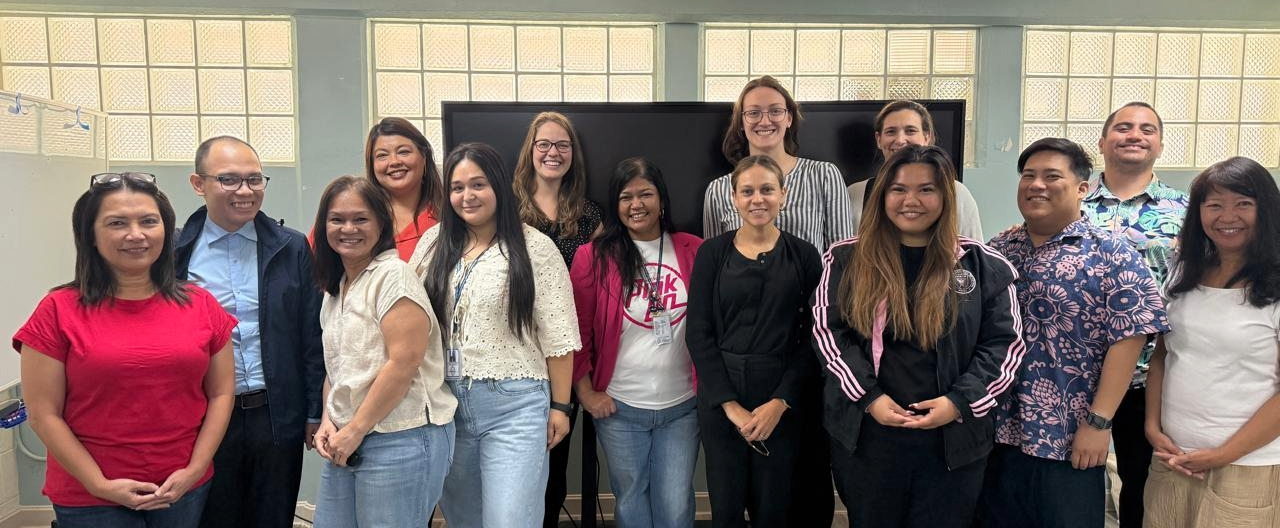
Guam Workforce Planning Committee with de Beaumont, ASTHO, and PIHOA staff in office building.
In Guam, Håfa Adai is more than a greeting. Often understood as a warm, “how are you” or “what’s up,” it’s a way of showing care for one another. It reflects the spirit and resilience of the island’s people, and it’s a reminder that community comes first — a value that shapes everything the Guam Department of Public Health and Social Services (Guam DPHSS) does.
Guam’s public health system is unique. A single, unified public health and social services agency, Guam DPHSS, handles everything from emergency response to chronic disease prevention to social services for 160,000 residents. That kind of responsibility demands a workforce that is steady, adaptable, and ready for whatever comes next.
Strength, Resilience, and Missing Pieces
Guam DPHSS stands ready to respond to natural disasters like typhoons, which are frequent in Guam.
“We are very resilient, and we have to be because of our geography,” said Ms. Bertha Taijeron, program coordinator at Guam DPHSS. “The closest state to Guam is Hawaii, which is about a seven-hour flight. When there is a storm and a disaster, we’re on our own for the first couple of days until resources and support come through. So, we try our best to support our island community with the resources we have.”
That determination and resilience extend to their workforce development efforts. For years, the department had been working toward accreditation, strengthening its systems, and modernizing its workforce infrastructure.
But one thing was missing.
They needed a comprehensive, trusted, and confidential way to understand the needs and experiences of their workforce. Although they had a sense of the department’s strengths and challenges from a patchwork of internal surveys and anecdotal knowledge, what was missing was validated, comparable, and actionable data to drive long-term planning.
So when Guam DPHSS was invited to participate in the first Public Health Workforce Interests and Needs Survey (PH WINS) in the Pacific Islands, they were thrilled.
“We were excited to be part of the PH WINS Islands Pilot,” Ms. Caitlin Moreno, program coordinator at Guam DPHSS, said. “It was the first time we could capture the experiences of our workforce in this way. And because we were already preparing to update our workforce development plan, the timing couldn’t have been better.”
Our Culture, Our Way
Capturing this data was essential. PH WINS would become the backbone of the Guam DPHSS workforce development plan and a catalyst for everything that followed. But it had to be done in a culturally responsive way.
First, they needed to adjust the survey’s demographic categories to align with the racial and ethnic groups prevalent in their region. The second issue was the dissemination method. They wanted an open-link survey option to protect anonymity and allow people to answer honestly and confidentially without the worry of being identified by email addresses. Third, they wanted division-level findings for those with enough respondents. The de Beaumont Foundation worked with Guam on all issues, and that support and assurance made all the difference.
Guam DPHSS Director Theresa Arriola, MBA, and department leaders championed the effort. They offered time-off incentives and created friendly division competitions. With roughly 507 employees, Guam DPHSS achieved a 56% response rate, surpassing its benchmark. Five of the seven divisions even earned enough responses to receive division-specific data.
It’s [PH WINS] not just a survey. It gives you resources and shows you how to turn data into action.
PH WINS Data Arrives at the ‘Cooking Ground’
In October 2025, Guam DPHSS hosted a two‑day PH WINS Workforce planning workshop at the Sinajaña Community Center. Sinajaña, which means “cooking ground,” was an apt setting for what they were about to do with the data. In collaboration with de Beaumont and the Association of State and Territorial Health Officials (ASTHO), Guam DPHSS began preparing and transforming that raw data into edible, usable insights they could act on.
They set ambitious goals: orient leadership to the PH WINS data dashboard, strengthen the Workforce Planning Committee’s capacity to use the data, and leave with a draft workforce plan aligned with accreditation planning. They accomplished all three.
“We sort of knew our department,” Ms. Moreno said. “But to finally have the data to support what we were seeing was really helpful. It confirmed these were facts, not assumptions.”
PH WINS findings revealed that one-third of employees were aged 55 or older, underscoring the need for intentional succession planning. More than half of the staff had been with the department for fewer than five years, reflecting a rapidly changing workforce and the importance of preserving institutional knowledge. Job satisfaction was high, but concerns about pay and burnout posed risks to retention. Staff identified training needs in budgeting and financial management, systems thinking, and change management, while also highlighting strengths in communication, data‑based decision making, and programmatic expertise.
Beyond the PH WINS data, the workshop surfaced gaps in Guam’s workforce information systems, including the need for more consistent tracking of recruitment, retention, training participation, and workforce well-being.
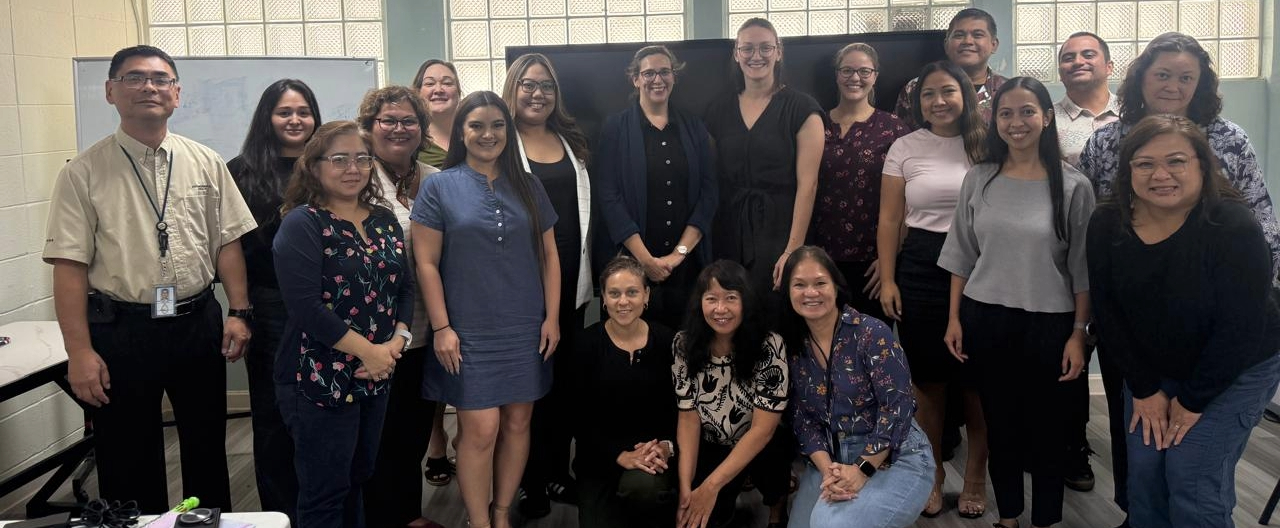
Guam Leadership with de Beaumont, PIHOA, and ASTHO staff in office building.
Two Days of Cooking: A Recipe for Moving from Raw Data to Clarity to Action
Raw Data – Before the workshop even began, Guam DPHSS leadership met with the de Beaumont and ASTHO teams to review Guam’s PH WINS results. They explored demographic trends, training needs, and division-level insights that would shape the days ahead. For many, it was the first time they had seen their workforce represented in a comprehensive, data-driven way.
Clarity – On Day 1 of the workshop, the Workforce Planning Committee learned to navigate the dashboard, export division-specific PowerPoints, and compare Guam’s data to national benchmarks. Ms. Moreno was especially impressed with Insights to Action, which connects data to resources and evidence-based strategies. “It doesn’t just give you data,” she said. “It tells you what to start focusing on.” The team also conducted a data-mapping activity to identify where workforce information was strong and where gaps remained.
Action – On Day 2, they were ready to take the next step. “We actually started writing the plan,” Ms. Moreno said. “By the end of the workshop, we had a full draft.” Facilitators from de Beaumont and ASTHO helped guide the team as they developed SMART objectives, aligned their goals with Public Health Accreditation Board standards and measures, and identified strategic priorities:
- Developing capable and confident employees
- Strengthening recruitment and retention strategies
- Enhancing employee support systems
More Plans in Store for PH WINS Data
The Guam DPHSS workforce development plan is grounded entirely in PH WINS and set for publication in June 2026. The data didn’t just inform the plan. It shaped it. The department is also using PH WINS to support its organizational strategic plan, quality improvement plan, and accreditation readiness with the goal of achieving accreditation in June 2027.
“Accreditation is accelerating our journey,” said Ms. Taijeron. “PH WINS is just one component, but it’s a powerful one. It’s not just a survey. It gives you resources and shows you how to turn data into action.”
For Ms. Taijeron, the data carries personal meaning. “I’m one of those who will be retiring soon,” she said. “The data helps ensure we continue to train and groom our workforce for the future.”
Ultimately, what will it take for Guam DPHSS to achieve its vision? “You have to find those champions.” According to Ms. Taijeron, “You have to find those individuals that are willing to do the work and who believe that what we’re doing is the work.”
Have you been using PH WINS? Let us know! Please fill out this short form to share how you and your agency are using PH WINS to inform your work. Your feedback helps us highlight how PH WINS data drives public health progress — no story is too small.