
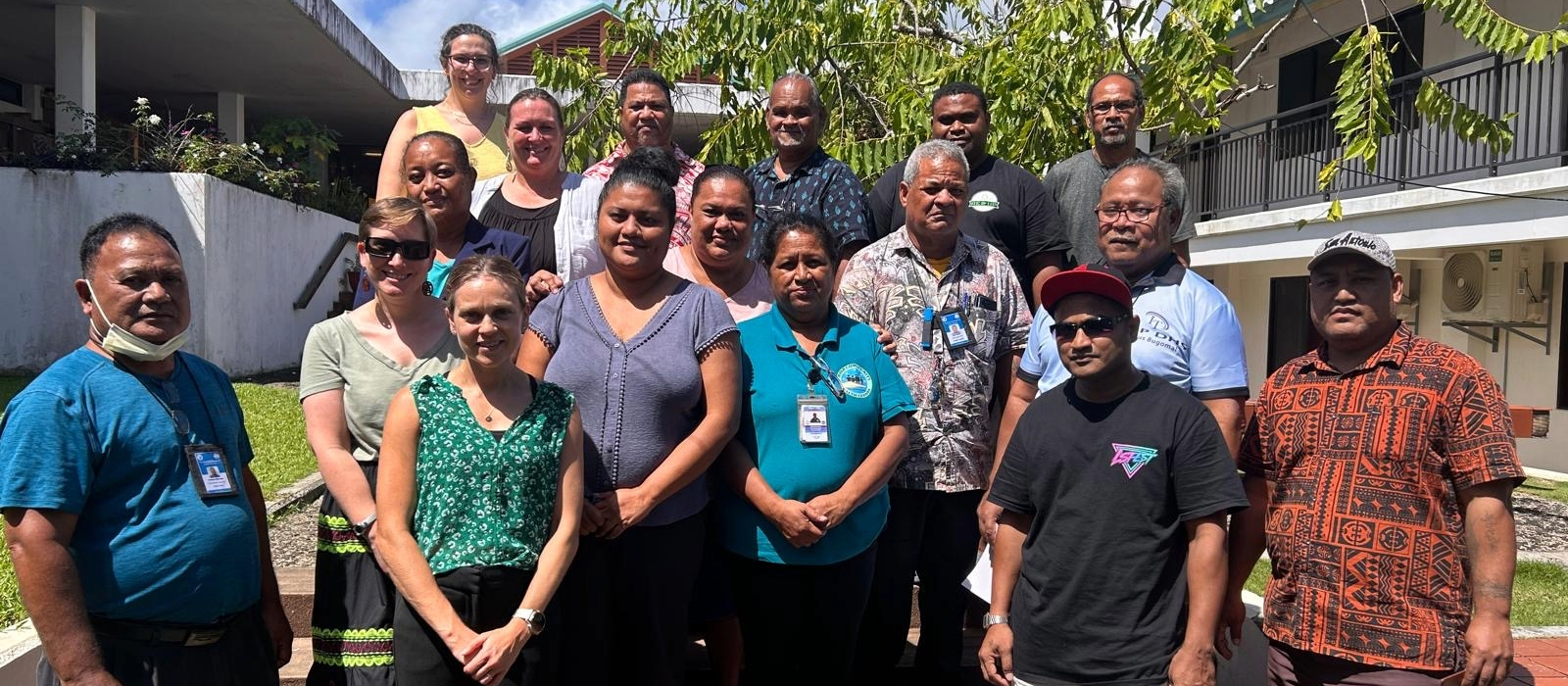
Yap Leadership with de Beaumont and ASTHO staff on island. Photo courtesy of Yap Department of Health Services
The Federated States of Micronesia (FSM) is an independent nation in the Pacific tied to the United States through the Compacts of Free Association. On the western side of FSM sits a cluster of quiet islands surrounded by 100,000 square miles of ocean — the beautiful state of Yap. Yap is rooted in a culture of collective responsibility in which people are cautious with their words to avoid creating problems for others.
So when Yap’s Department of Health Services (DHS) was invited to take part in the first-ever Public Health Workforce Interests and Needs Survey (PH WINS) Islands Pilot in the Pacific Islands, they welcomed the opportunity.
“People here keep things to themselves,” said DHS personnel officer Barbara Tineg. “We don’t want to raise a concern and get somebody else in trouble. So the conversations happen quietly, with relatives, at the dinner table, in small circles. But they’re real.”
Participating in the survey was a rare opportunity for DHS staff to speak honestly while preserving relationships.
Roughly two-thirds of Yap’s 230‑member workforce responded, one of the region’s highest participation rates. That number gave a clear signal that DHS staff care about where they work and want to provide beneficial feedback.
Having the ASTHO and de Beaumont team walk through the data with us was really helpful.
From Unspoken Truths to Clarity: Strengths and Challenges
In February 2026, the de Beaumont Foundation, the Association of State and Territorial Health Officials (ASTHO), and the Pacific Islands Health Officer Association (PIHOA) hosted a two‑day workshop offering Yap’s workforce leaders the opportunity to see the data and the space to talk collectively about what it meant.
On Day 1, the group explored the PH WINS data dashboard, compared Yap’s results to U.S. results, discussed patterns in staff experiences, and named the challenges that had been quietly present for years. For many, it was their first time using workforce data in this way.
“I’m not used to working with this kind of data,” Ms. Tineg said. “In my previous line of work, I was an accountant, so I dealt with numbers, but this job is different. Having the ASTHO and de Beaumont team walk through the data with us was really helpful.”
Many anecdotal insights were confirmed with actionable data. “We knew there were challenges,” Ms. Tineg said. “But the results were eye‑opening.”
There was much to celebrate. The data revealed a workforce that is deeply committed to serving Yap’s communities. Staff have high job satisfaction, a strong sense of belonging, and pride in their work. Compared with U.S. data, fewer staff plan to leave in the next year. Also, many felt their agency involved community members in decision making, a sentiment rooted in Yap’s culture of collective responsibility.
Alongside those strengths were longstanding challenges:
- Satisfaction with salaries and benefits were both low, especially for nurses and other health professionals.
- Burnout was common among supervisors and long‑tenured staff who had been carrying heavy workloads for years. The workforce was stretched thin, with clinics spread across 17 outer‑island sites.
- Recruitment processes were slow and complex, sometimes taking six months or more.
- Fragmented data systems made it hard to plan effectively.
- Staff needed training in budgeting and financial management, policy engagement, and change management, but opportunities were limited. Off‑island training was especially hard for long-tenured workers, who lacked the time, staffing coverage, and logistical support to attend.
These weren’t surprises. They were confirmations, now visible in the data.
“It’s not the work,” Ms. Tineg said. “They love their work. It’s the salary. The burnout. The need for more training.”
For the first time, Yap had the evidence it needed to guide decisions.
From Clarity to Strategy: A Vision for the Future
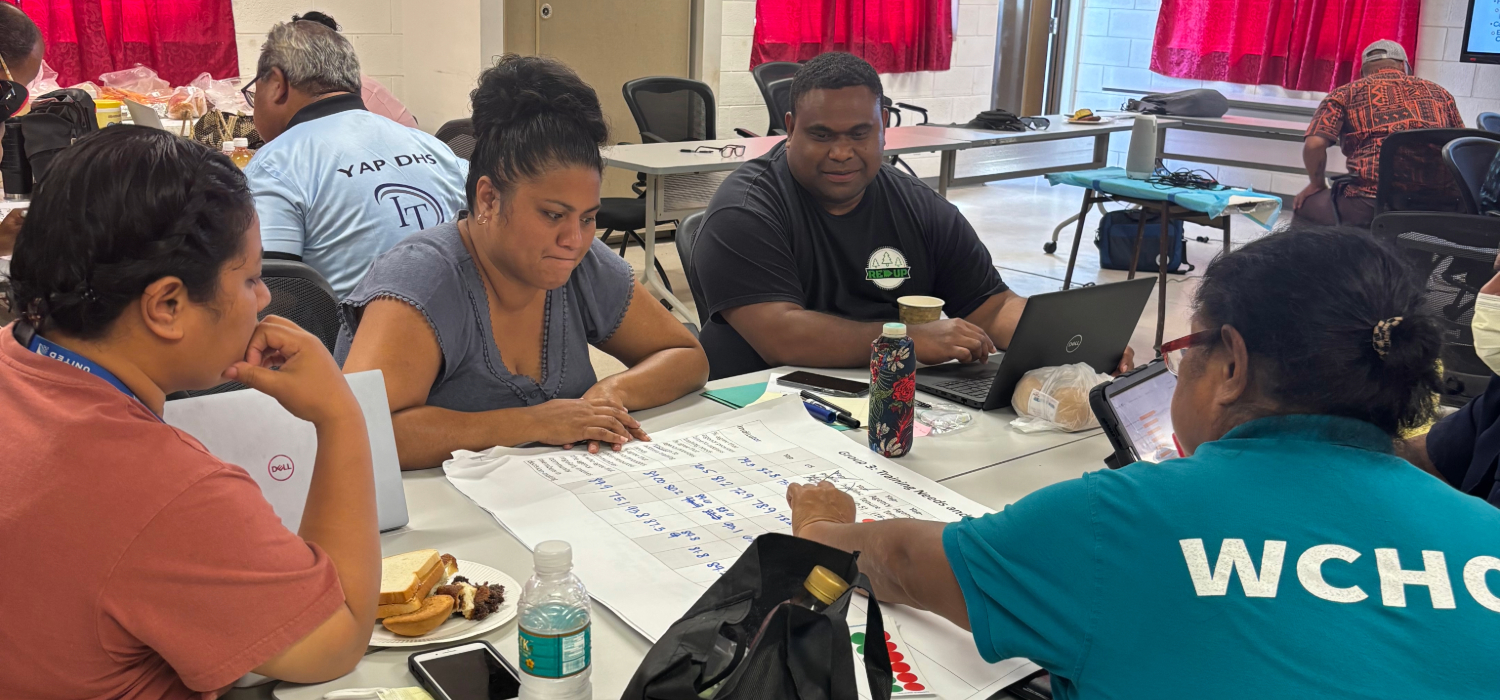
Yap TA workshop. Photo courtesy of Yap Department of Health Services
On Day 2, the group moved from clarity to strategy, and participants were asked to draw their vision of an ideal future workforce.
Their sketches were hopeful. They wanted to see a workforce that is supported and resilient with better benefits and fairer salaries. They wanted more training and professional development. They envisioned improvements in retention, balance, and growth, as well as a department with clear processes and less fragmentation.
Then they named the solutions that would draw on an ideal future:
- Consistent funding
- Updated HR policies and procedures
- Streamlined hiring by improving the recruitment process
- Ability to send staff off island for training
- Data governance integration across programs
- Transportation improvements for both local and outer‑island service delivery
- Clear pipelines for young people entering health careers
- Development of a unified workforce plan
“One of the main reasons we are facing all these challenges is that we don’t have a plan in place at our health department,” Ms. Tineg said.
For the first time, the challenges were not whispered. They were written down, discussed, and acknowledged — together.
By the end of the workshop, DHS had identified four priority strategies:
- Create a workforce strategic plan
- Establish a workforce database
- Strengthen recruitment and retention
- Reduce data fragmentation across programs
For a department that has never had a workforce plan, this was a major shift.
As of April 2026, the team is preparing to present the action plan to their director and the hospital board, a step toward building the structure they’ve long needed.
PH WINS helped the Department of Health Services in Yap move from silence to clarity to strategy.
The data gave the workforce a voice.
The workshop gave them a path.
And now, the plan they are building will give them the future they’ve been hoping for.
Have you been using PH WINS? Let us know! Please fill out this short form to share how you and your agency are using PH WINS to inform your work. Your feedback helps us highlight how PH WINS data drives public health progress — no story is too small.