
Schaffer K, Porter JM, Bell C, Castrucci BC. “From Words to Action: Equipping the Public Health Workforce to Advance Health Equity,” de Beaumont Foundation. May 2025
As the providers of essential public health services, state and local public health employees are uniquely positioned to take on the root causes of structural racism in communities nationwide. Findings from the Public Health Workforce Interests and Needs Survey (PH WINS) reveal insights about readiness of the workforce to address racism, barriers to this work, and opportunites to prioritize anti-racism efforts in health departments.
A May 2025 report, From Words to Action: Equipping the Public Health Workforce to Advance Health Equity, offers critical insights into the workforce’s capacity and readiness to advance health equity—and practical steps agencies can take to drive meaningful change.
This report builds on a quantitative study of PH WINS 2021 data, Public Health Employees Eager to Address Racism as a Public Health Crisis, released in October 2023. The study is the first exploration of public health employees’ views on addressing racism as a public health crisis, how much they have been involved in such efforts, and the resources and support they need.
Key findings:
- Equity efforts are often viewed as “extra” work taken on by a few motivated staff, rather than integrated into the core responsibilities of all employees.
- Barriers to effectively address systemic inequities include unsupportive organizational policies and culture, directives from leadership that restrict certain actions and language choices, and a lack of prioritization for these efforts.
- Many health departments have published statistical data on racial inequities, but there has been little effort to act on these data to address the inequities.
- Many health departments have been unwilling to change internal policies and practices to embrace equitable approaches.
- Nearly three-quarters of state and local government public health employees (72%) believe that addressing racism as a public health crisis should be part of their work within their agencies. However, only about 4 in 10 (39%) reported being highly engaged in such efforts.
- A strong majority of public health agency executives (81%) believe that addressing racism should be part of their work.
- More than half of public health workers (58%) say they lack adequate funding to address racism as a public health crisis.
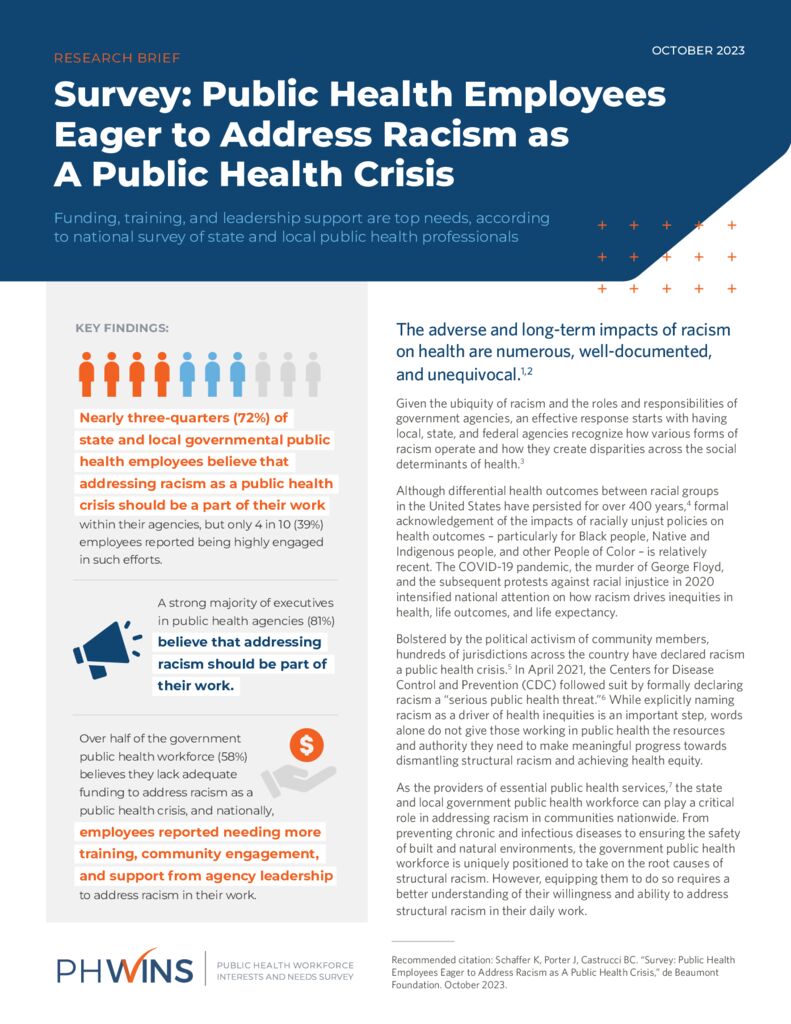
Schaffer K, Porter J, Castrucci BC. “Survey: Public Health Employees Eager to Address Racism as A Public Health Crisis,” de Beaumont Foundation. October 2023