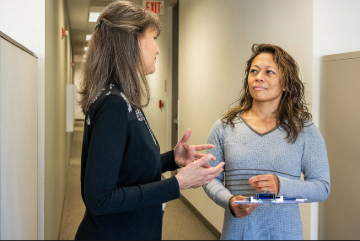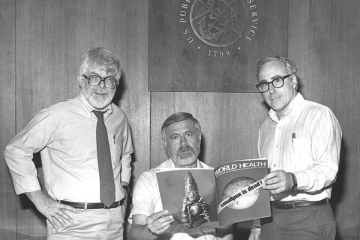
The National Association for Doctors of Public Health’s (NADrPH) Board of Directors. Photo collage courtesy of NADrPH.
In 1988, a landmark report from the Institute of Medicine famously asked, “Who will keep the public healthy?” It highlighted the need for leaders trained to manage public health systems, engage with diverse stakeholders, and navigate political and economic complexities. These skills — now more important than ever for practitioners — are embodied in the Doctor of Public Health (DrPH) degree and career path.
The DrPH is a leadership degree for people who want to solve real problems in public health. It trains professionals to carry out programs, forge partnerships across sectors, make policy, and respond to crises — not just study them. DrPH professionals use leadership, research translation, and systems-thinking skills to drive innovation in health departments, build capacity in community-based organizations, and shape policy in federal agencies.
What Defines a DrPH Leader?
DrPH leaders are trained to connect science, policy, and community to drive practical solutions and advance health equity. They adopt a broad, systemic perspective that considers not only biological threats to population health, but also the social, economic, and policy conditions that shape how communities experience crises.
With this perspective, DrPH practitioners understand how factors such as job loss, housing instability, and structural inequities deepen disparities. They translate science into practice and coordinate across complex systems to reduce inequities, such as access to health services and health education. By engaging communities, building trust, and shaping responsive policies, DrPH-trained professionals ensure that evidence is applied where it matters most.
The COVID-19 pandemic is a prime example of DrPH leadership in action. During the pandemic, DrPH-trained practitioners acted as the connective tissue across scientific, medical, community-based, and political systems. They translated evolving data into action, built trust across sectors, and mobilized resources, demonstrating the critical role of public health leadership in times of disruption.
DrPH or PhD — What’s the Difference?
Although the DrPH and PhD are often conflated, they serve distinct purposes in public health. A PhD in public health is designed to generate new research and advance scientific knowledge, most often within academic and research settings.
In contrast, the DrPH is practice-oriented, preparing leaders to apply research evidence in real-world contexts — turning knowledge into action in communities, health departments, health care systems, and government. DrPH-trained professionals bridge research and practice, translating evidence into action and aligning cross-sector teams to improve population health.
Whereas an MD may ask, “What is the best treatment?” and a PhD may ask, “What does the data show?”, a DrPH leader asks, “Why is this system producing these outcomes, and who has the power to change it?”
What Do You Learn in a DrPH Program?
The Harvard School of Medicine established the first DrPH program in the United States in 1909. Back then, the country needed health leaders to manage sanitation and disease outbreaks in booming cities. More than a century later, the need for bold public health leadership has only intensified, and DrPH programs are helping students meet this pivotal moment.
DrPH students are trained in a broad, interdisciplinary curriculum grounded in leadership, systems thinking, equity, and applied science. Besides foundational courses like biostatistics and epidemiology, they take classes in:
- Leadership and change
- Strategic communication and health messaging
- Stakeholder engagement and community partnership
- Policy and systems thinking
- Program design and evaluation
- Applied research and implementation science
Implementation science models like RE-AIM are not just tools for program evaluation but also frameworks for driving systems change. These models help DrPH leaders assess readiness, align stakeholders, and embed evidence into practice sustainably. Frameworks like adaptive leadership help students navigate uncertainty and resistance, while transformational leadership prepares them to shift culture and inspire change. They are taught to think strategically, act decisively, and lead ethically.
Why Pursue a DrPH Degree Now?
With a growing demand for DrPH-trained professionals who understand both science and systems, now is a great time to consider pursuing a DrPH degree and career path.
Public health emergencies like infectious disease outbreaks and ongoing threats to health equity underscore the need for more DrPH-trained practitioners. They can navigate volatile environments where public trust is fragile and resources are scarce. They know how to make timely and transparent decisions, even when science is still developing. And they stand up for community members who have been marginalized and are most vulnerable to systemic inequities.
The Doctor of Public Health is more than just a degree — it’s a call to lead. If that’s you, we invite you to learn more, talk to alumni, and join the movement!
For more information on the National Association for Doctors of Public Health and the Doctor of Public Health degree, visit www.nadrph.org.
Veronica Natale, MPH, CPHQ, Marissa Robinson, DrPH, MPH, RPCV, and Charanya Sundar, DrPH(c), MS, RDN/LD, are NADrPH Executive Board members.