Explore the toolkit.
Effective public health practice starts with effective communication. Every policy, decision, and investment in public health directly affects people’s lives — from the water that flows from our taps, to the safety of our neighborhoods, to the opportunities we have to live full and healthy lives.
But public health professionals cannot meet today’s challenges alone. Practitioners need to communicate and collaborate with policymakers because their decisions shape how resources are allocated, priorities set, and policies made that determine community health outcomes.
Communicating effectively with policymakers about public health is challenging for several reasons. Often, the tangible benefits of public health investments — which tend to be long term and preventive — can feel “invisible” to policymakers who are looking for shorter-term wins. The current climate provides even more challenges: Previously common-sense public health efforts have become politicized, polarized, and fraught with false and misleading information.
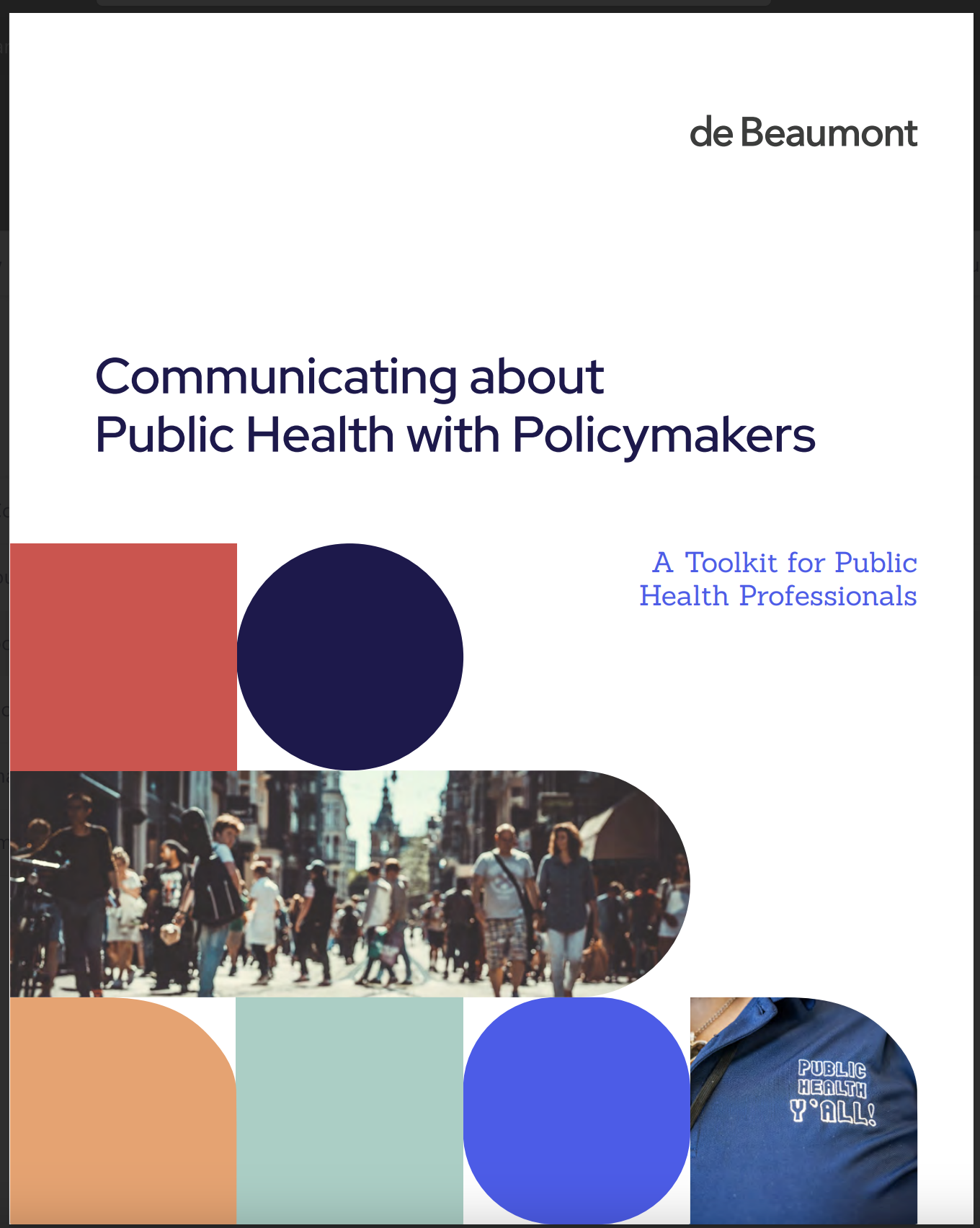
Launching today, Communicating About Public Health with Policymakers provides research-based, practical guidance for explaining important issues to policymakers and motivating them to support policy solutions. The toolkit includes:
- Insights from elected officials and senior aides that explain the current “trust gap”
- A message formula for communicating with policymakers
- Examples of public health initiatives that show the value of the field
- Message do’s and don’ts
- Recommendations for enlisting credible messengers
- Tips for engaging and interacting with policymakers
Barriers to Trust and Framing Strategies to Overcome Them
Focus groups with former state and local elected officials and senior aides across political affiliations revealed three key perceptions that fuel distrust of public health professionals, making it more difficult for public health advocacy messages to break through. The new toolkit provides framing strategies to counter each of these perceptions.
Zero Sum: Policy insiders see public health as zero-sum. They believe it inherently involves difficult tradeoffs, which they don’t always see as worthwhile. To overcome this perception, public health professionals should showcase the aspirational impact of their work, positioning public health as a force strengthening both local well-being and economic vitality, rather than one inherently requiring a tough tradeoff.
Ideological: Many policy insiders believe public health professionals are following an ideological agenda and don’t think about the many non-health factors a policymaker must consider. Public health professionals can overcome this perception by emphasizing the local, listening nature of their work, showing that their recommendations are based on listening to communities about their needs rather than pushing an ideological agenda.
Ignores Individual Agency: Some policy insiders believe public health professionals ignore the role individuals play in shaping their own health, undermining the field’s credibility with this group. To overcome this perception, public health professionals should show how community health and individual control are complementary: when communities are healthier, people can make healthier choices for themselves and their families.
Applying the Strategies in Real-World Settings
With these perceptions and strategies in mind, the toolkit includes examples and templates for translating your policy priorities — whether big-picture or issue-specific — into messages likely to resonate with policymakers.
In a webinar launching the toolkit, “Communicating About Public Health with Policymakers: Barriers, Strategies, and Tested Messages,” policy and advocacy experts discussed how to apply these framing strategies in real-world settings. Katrina Forrest, executive director of CityHealth; Susan Polan, associate executive director for public affairs and advocacy at the American Public Health Association; and Amy Maxson, senior program manager at the National Association of Counties, shared their experiences and best practices for interacting with policymakers, researching individual elected officials’ priorities, and customizing messaging to address what they care about most.
In particular, the panelists stressed the importance of the finding the “what’s in it for me” angle for policymakers, positioning public health as an opportunity to build their legacy and work across political divides, and remembering the long game.
Communicating About Public Health with Policymakers, released in December 2025, is based on an extensive round of research with former state and local elected officials and senior aides. We conducted five focus groups with policy insiders from politically competitive “purple” states (Georgia, Michigan, Minnesota, Nevada, North Carolina, Ohio, Pennsylvania, Wisconsin) from August 12-14, 2025. Two focus groups were composed of Democrats, two of moderate Republicans, and one of conservative Republicans aligned with the MAGA movement.
For guidance on communicating about public health with the general public, see Communicating About Public Health: A Toolkit for Public Health Professionals, released in February 2025.